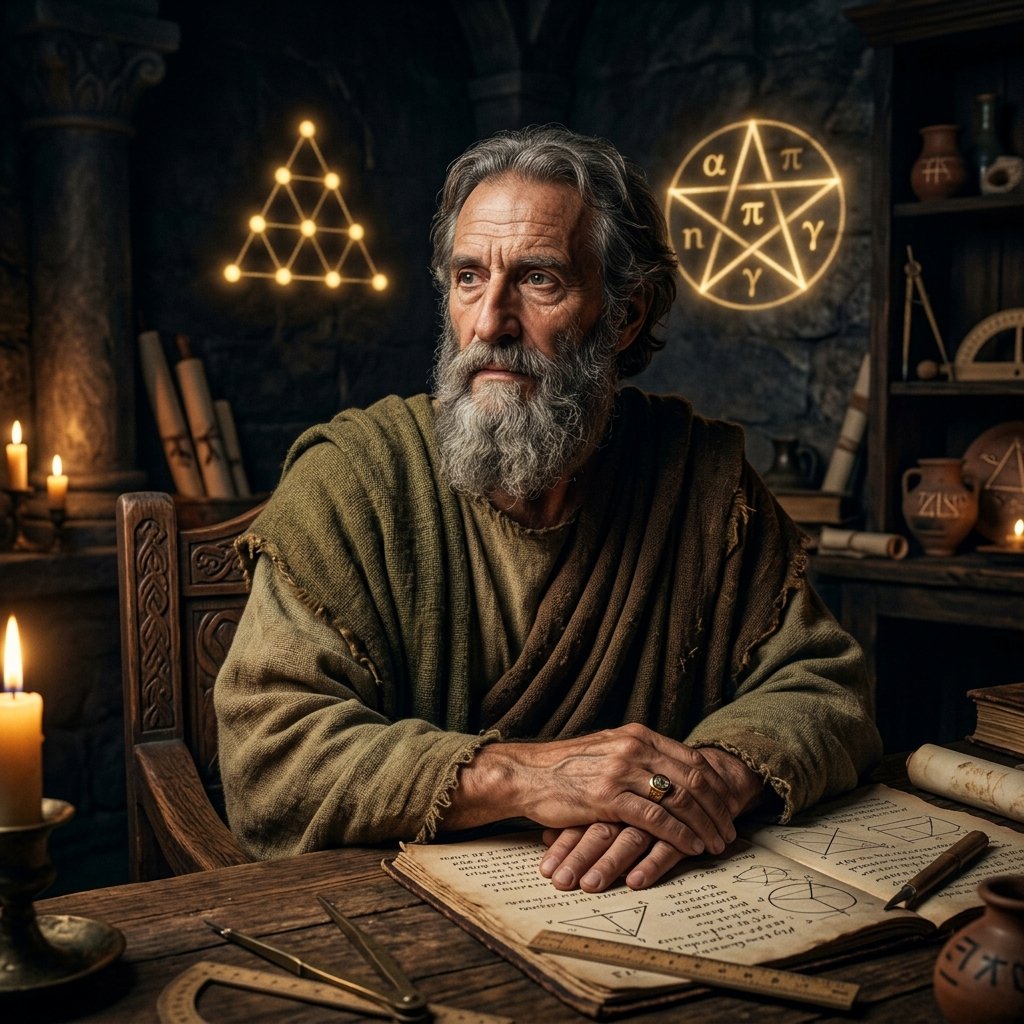
🔺 Pythagoras — Mystery Number and Harmony
5 modules · 20 initiation cycles
Explore the mystical and mathematical teachings of the school of Croton.
The Divine Avatar and the Masters of the East
The Hyperborean Apollo
🎯 Understand why Antiquity unanimously perceived Pythagoras as a supra-human being — son of Apollo or Hermes according to sources — and master the three major biographical sources (Iamblichus, Porphyry, Diogenes Laërtius) that establish this tradition.
This oracular birth is no anecdotal curiosity. It places Pythagoras in a precise spiritual category the Greeks called theios anêr — the divine man. This category, which would later include Empedocles, Apollonius of Tyana and Plotinus, designates a being whose soul is of superior essence, capable of acts impossible for ordinary mortals. Tradition records that Pythagoras was seen simultaneously at Metapontum and Croton on the same day (bilocation). He reportedly calmed a raging bear of Daunia by voice alone, stilled a sea storm, and predicted an earthquake by tasting spring water.
But who really was this man? Caution is needed: Pythagoras wrote nothing himself — or nothing survives. Everything we know passes through a filter of 500 to 800 years. Our three major sources are: Iamblichus (245-325 CE), most prolific but also latest, writing in the Neoplatonic tradition; Porphyry of Tyre (234-305), his contemporary and rival, more sober and critical; and Diogenes Laërtius (3rd c. CE), a compiler of sometimes contradictory traditions.
This chronological distance does not disqualify our sources — it obliges us to read differently. When Iamblichus says Pythagoras was an avatar of Apollo, he transmits a conviction already present in Aristotle (384-322 BCE), who had access to Pythagorean texts now lost. Aristotle himself reports that the Pythagoreans distinguished three species of rational beings: gods, men, and Pythagoras. This is not hyperbolic flattery — it is an ontological classification.
The link to the Hyperboreans — mythical people living 'beyond the North Wind' in eternal solar bliss — is not trivial. Apollo himself was associated with the Hyperboreans: he spent winter months in their blessed land. To call Pythagoras a 'Hyperborean Apollo' means he belongs to a solar, Apollonian reality transcending ordinary temporality. His entire life will be an attempt to transmit to mortals what the Immortals know: the mathematical order structuring the universe.
⚡ Key Points
- 🌟 Oracular birth: the Pythia announces Pythagoras to his father — his name means 'he whom the Pythia announced'
- ⚡ Theios anêr: Greek category of divine man, distinct from ordinary humans (bilocation, voice miracles)
- 📚 3 major sources: Iamblichus (richest), Porphyry (most sober), Diogenes Laërtius (compiler)
- ⏳ Source problem: everything written 500-800 years later — but tradition already goes back to Aristotle
- ☀️ Hyperborean Apollo = soul of solar essence, transcending ordinary temporality
- 🔺 Aristotle's classification: 3 species of beings — gods / men / Pythagoras
🧠 Validation Quiz
What does the name 'Pythagoras' mean according to the tradition reported by Diogenes Laërtius?
What classification did Aristotle attribute to the Pythagoreans regarding species of rational beings?
The Pilgrimage of Knowledge
🎯 Reconstruct Pythagoras's initiatic itinerary through the ancient East — Egypt, Phoenicia, Babylon, possibly India — and understand how these travels forged the core of his philosophy: sacred geometry, divine arithmetic and the theory of metempsychosis.
The first stop is Phoenicia (modern Lebanon). According to Iamblichus, Pythagoras stays with the priests of Tyre and Sidon, heirs of a millennia-old astronomical tradition. He absorbs the mysteries of Byblos and Tyre, notably the esoteric rites linked to Adonis — the dying and resurrecting god who prefigures the Pythagorean reflection on the death and rebirth of the soul.
The central and longest stop is Egypt. Iamblichus reports that Pythagoras spends twenty-two years in the temples of Memphis and Heliopolis, initiated by the priests of Amun and Ptah. This figure may be inflated, but the reality of links between Pythagoras and Egypt is independently attested. Herodotus (484-425 BCE), contemporary with the first Pythagoreans, notes that Greek dietary prohibitions resembling Pythagorean ones (especially abstinence from beans and meat) are of Egyptian origin. Isocrates (436-338 BCE) explicitly states that Pythagoras was a disciple of the Egyptians before bringing their philosophy to Greece.
What does he receive in Egypt? Three fundamental transmissions: first, practical and sacred geometry — Egyptian priests were custodians of geometric knowledge used to recalibrate land after Nile floods, and also to orient temples by the stars. Second, mystical arithmetic — the doctrine of numbers as divine essences that Pythagoras would elevate to an unprecedented philosophical level. Third, the doctrine of the soul's immortality and its migration through successive bodies — what the Greeks would call metempsychosis, codified by the Egyptians in the Book of the Dead.
The third great stop is Babylon. According to Porphyry, Pythagoras is taken there as a captive by Cambyses II during the Persian conquest of Egypt (525 BCE) — a reversal of fortune that proves an intellectual windfall. In Babylon he frequents the Magi (Zoroastrians) and Chaldean priest-astronomers, heirs of centuries of astronomical observation. Aristoxenus of Tarentum (a disciple of Aristotle with direct knowledge of the Pythagorean school) confirms that Pythagoras received the core of his ethical and arithmetical doctrines from the Magi. It is in Babylon that he meets the sage Zaratas — probably a figure of Zoroaster — whose teaching on cosmic duality (light vs darkness) would inflect his cosmology.
Some sources also mention a journey to Arabia and the borders of India, among the Brahmins — but this tradition is less solidly attested. What is certain is that Pythagoras returns to Magna Graecia bearing an unprecedented synthesis: a philosophy that fuses in a single crucible Egyptian number, Chaldean astronomy and Zoroastrian ethics, all reinterpreted through the Greek prism of reason and harmony.
⚡ Key Points
- 🗺️ Itinerary: Phoenicia (Tyre/Sidon) → Egypt (Memphis/Heliopolis, ~22 years) → Babylon (captive of Cambyses II, 525 BCE)
- 🏛️ Egypt: 3 transmissions — sacred geometry, mystical arithmetic, metempsychosis (Book of the Dead)
- ⭐ Independent proof: Herodotus and Isocrates attest Pythagoras-Egypt links, well before Iamblichus
- 🔥 Babylon: contact with Zoroastrian Magi and Zaratas — light/darkness duality influences his cosmology
- 🌏 Unique synthesis: Egyptian number + Chaldean astronomy + Zoroastrian ethics = Pythagorean philosophy
- 📖 Key source: Aristoxenus of Tarentum confirms ethical and arithmetical transmission from the Magi
🧠 Validation Quiz
What historical event explains, according to Porphyry, Pythagoras's stay in Babylon?
What are the three fundamental transmissions Pythagoras receives in Egypt according to tradition?
The Matthew Effect
🎯 Understand the unequal access structure to knowledge in the Pythagorean school: why Pythagoras concentrated his deepest teachings on an elite, and how this principle prefigures the modern Matthew Effect.
First level: aspirants (probationers). Every candidate stands before Pythagoras, who observes them in silence for several years without teaching anything. Iamblichus reports Pythagoras studied physiognomy — reading character in facial features and gait. If the candidate lacks the required qualities, he is dismissed with a sum of money as compensation for his time. This forced silence phase lasts two to five years.
Second level: the Acousmatics (akousmatikoi, 'those who listen'). They receive exoteric teachings — moral maxims, rules of life, akousmata (cryptic sentences) — but remain behind a curtain and never see Pythagoras face to face. Their studies last three to five additional years.
Third level: the Mathematicians (mathêmatikoi, 'those who learn'). The elite. Only they have access to esoteric doctrines: arithmetic of divine numbers, sacred geometry, music of the spheres, metempsychosis. They live with Pythagoras, share his meals, witness his demonstrations.
This is the Matthew Effect before the term existed. Matthew 25:29: 'For to everyone who has, more will be given, and he will have abundance; but from him who does not have, even what he has will be taken away.' Sociologist Robert Merton (1968) named this in modern pedagogy: the most gifted students receive the best teachers' attention, accumulate advantages, widen the gap. Pythagoras, 2500 years before Merton, applies this principle deliberately and radically.
The direct consequence: most of the deepest Pythagorean doctrines were never written. They were transmitted only orally, from master to elite disciple. This is why we possess only fragments and indirect testimonies today.
⚡ Key Points
- 🏛️ 3 levels: Probationers (silence/observation) → Acousmatics (curtain/exoteric) → Mathematicians (esoteric/elite)
- 👁️ Physiognomy: Pythagoras selects disciples by reading character in their features and gait
- 📖 Matthew Effect: deliberate principle — deepest knowledge goes to the most capable, widening the gap
- 🤐 Consequence: deepest doctrines were never written — transmitted orally from master to elite
- 🔬 Robert Merton (1968) would name this phenomenon 2500 years later in sociology of science
🧠 Validation Quiz
What do the Acousmatics receive as opposed to the Mathematicians in Pythagoras's school?
Metempsychosis and the Buddha
🎯 Understand the Pythagorean doctrine of metempsychosis and its parallels with Buddhist samsara, born in the same century (6th c. BCE).
For Pythagoras, metempsychosis is a lived certainty. He claims to remember past lives: he was Euphorbus (Trojan warrior), Hermotimus (prophet), a fisherman, then Pythagoras. The soul is immortal; the body is a tomb (soma = sema). Philosophy purifies the soul to escape the cycle of rebirths.
Empedocles (490-430 BCE), Pythagorean disciple: 'I have been a boy, a girl, a bush, a bird, and a dumb sea-fish.'
Buddhist parallels: samsara, karma, body as temporary prison, final liberation. Key difference: Buddhism suppresses desire to reach nirvana; Pythagoreanism purifies the soul through the science of numbers to merit return to the divine One.
⚡ Key Points
- 🔄 Metempsychosis: immortal soul migrating body to body — soma = sema (body = tomb)
- 🧘 Axial Age: Pythagoras and Buddha ~570 BCE — same transmigration doctrine, two separate civilisations
- 🐟 Empedocles: 'I have been a boy, a girl, a bush, a bird, and a dumb sea-fish'
- ⚖️ Key difference: Buddhism = suppress desire; Pythagoreanism = purify through the science of numbers
🧠 Validation Quiz
What is the fundamental difference between Pythagorean liberation and Buddhist nirvana?
Sacred Acoustics and Healing
The Anvil the Hammer and the Ratios
🎯 Understand how Pythagoras discovers harmonic ratios by observing blacksmiths, founding Pythagorean musicology and cosmology.
The anecdote is physically inaccurate but encodes a truth: Pythagoras transfers these experiments to the monochord, where physics confirms the same ratios. Philosophical conclusion: if music is numbers, the entire universe is structured by numbers. The planets too produce music in their movement - inaudible to mortals, but real. This is the Music of the Spheres.
⚡ Key Points
- 🔨 Forge: 2:1=octave, 3:2=fifth, 4:3=fourth — consonance is a numerical ratio
- 🎵 Monochord: experimentally confirms the same ratios on a string
- 🔢 Conclusion: music = numbers → the whole universe is structured by numerical ratios
- 🌌 Music of the Spheres: planets produce inaudible music based on these same ratios
🧠 Validation Quiz
Which numerical ratio corresponds to the octave?
The Music of the Spheres
🎯 Understand the Pythagorean doctrine of the Music of the Spheres: how planetary distances correspond to musical intervals, and why mortals cannot hear it.
According to Iamblichus and Nicomachus, Pythagoras assigns each planet a musical note based on its distance from Earth and speed of revolution. The Moon, nearest, emits the lowest note. Saturn, farthest, the highest. Between them, the six known planets form a complete scale.
Why can mortals not hear it? Aristotle reports the Pythagorean answer: because we have heard this music since birth, never knowing silence. Like someone living near a forge who stops hearing the noise, humans have become accustomed to the cosmic music. Only Pythagoras, say his disciples, could truly hear it.
This doctrine influenced Plato (Republic, Myth of Er), Ptolemy (Harmonics), Kepler (Harmonices Mundi, 1619) and even modern physicists studying gravitational wave frequencies.
⚡ Key Points
- 🌌 Each planet = a note based on distance and speed; together they form a complete scale
- 🔇 Why inaudible: accustomed since birth — like a blacksmith who no longer hears his forge
- 👂 Only Pythagoras could hear it, say his disciples
- 🔗 Legacy: Plato (Myth of Er), Ptolemy (Harmonics), Kepler (Harmonices Mundi, 1619)
🧠 Validation Quiz
According to the Pythagorean answer reported by Aristotle, why do humans not hear the Music of the Spheres?
Harmonic Pharmacopoeia
🎯 Understand Pythagoras's therapeutic use of music through Greek musical modes.
Famous case: a drunken young man wanted to break down a door. Pythagoras asked the flute player to switch to the Dorian mode. The young man calmed immediately. Music reorganizes inner states. This prefigures modern music therapy.
⚡ Key Points
- 🎵 Dorian=calm, Phrygian=ardor, Lydian=anti-depression
- 😡 Case: drunk youth instantly calmed by mode change
- ☀️ Ritual: lyre morning/evening to regulate the soul
- 🏥 Prefigures modern music therapy
🧠 Validation Quiz
Which mode prescribed to calm anger?
The Silence of the Acousmatics
🎯 Understand the role of compulsory silence in Pythagorean training.
Pythagorean philosophy of speech: before speaking one must know; before knowing one must observe. Premature speech crystallizes ignorance. Some candidates failed the ordeal and were dismissed with their purse. Others, after years of silence, spoke incessantly: they had discovered their voice.
Contemporary echo: Zen, Vipassana, Carmelites practice the same truth. Silence is not the absence of sound - it is presence to oneself.
⚡ Key Points
- 🤐 Silence 2-5 years: listen without speaking or questioning
- 🧠 Before speaking: know. Before knowing: observe
- ❌ Failure = dismissed with purse
- 🧘 Zen, Vipassana, Carmelites: same contemplative principle
🧠 Validation Quiz
What was the minimum duration of compulsory silence for an Acousmatic?
The Source Code of the Universe
The Oath of the Tetractys
🎯 Understand the Tetractys: the sacred triangle of 10 points that summarizes all Pythagorean number philosophy and founds the school's most solemn oath.
First row (1 point) = the Principle, the One, the indivisible source. Second (2 points) = duality, the line, the first movement. Third (3 points) = the plane, surface, creative trinity. Fourth (4 points) = volume, three-dimensional space, matter. The sum 1+2+3+4=10 represents the totality of reality.
The most solemn Pythagorean oath was sworn not by the Olympian gods, but 'by him who transmitted to our soul the Tetractys, source and root of eternal nature.' For Pythagoreans, the mathematical concept surpasses the gods: numerical order is more fundamental than anthropomorphic divinities.
The 4 rows also encode music: the ratios 1:2 (octave), 2:3 (fifth), 3:4 (fourth) are all contained in the first 4 integers. This is why the Tetractys is simultaneously the key to music, geometry, cosmology and sacred arithmetic.
⚡ Key Points
- 🔺 Structure: 1+2+3+4=10 points — 1=Unity, 2=Duality, 3=Surface, 4=Volume
- 🙏 Oath: 'by him who transmitted to us the Tetractys' — number surpasses the gods
- 🎵 Musical ratios 1:2, 2:3, 3:4 all contained in the first 4 integers
- 🔑 Universal key: music + geometry + cosmology + sacred arithmetic
🧠 Validation Quiz
What do the 4 rows of the Tetractys represent?
The Eleven Tetractys of Theon
🎯 Discover how Theon of Smyrna extended the original Tetractys into eleven distinct Tetractys, encompassing all aspects of creation.
These eleven Tetractys cover the following areas: numbers (1, 2, 3, 4), magnitudes (point, line, surface, solid), simple bodies (fire, air, water, earth), figures (pyramid, octahedron, icosahedron, cube), living things (seed, spatial growth, animal growth, human being), societies (individual, family, village, city), cognitive faculties (reason, science, opinion, sensation), seasons (spring, summer, autumn, winter), ages of life (childhood, youth, adulthood, old age) and finally the constitution of the universe itself.
This all-encompassing vision shows that for the Pythagoreans, the cosmos is not a chaotic assemblage, but a divine fractal. The same law that governs geometry governs human society and biological development. The study of mathematics thus became a study of universal harmony.
⚡ Key Points
- 📐 Theon of Smyrna identifies 11 Tetractys in the universe
- 🌌 A fractal vision: the same law governs numbers, seasons, societies
- 🔄 From seed to universe: the 1-2-3-4 model applies to everything
- 🧠 Cognitive faculties (reason, science, opinion, sensation) also follow this model
🧠 Validation Quiz
How many distinct Tetractys did Theon of Smyrna identify?
The Myth of the Proof
🎯 Understand the importance of mathematical demonstration (the theorem) for Pythagoras and why legend says he sacrificed an ox in thanks.
For the Pythagoreans, a mathematical proof is not just an intellectual tool: it is a divine revelation. To prove a theorem is to access the mind of God, to contemplate the eternal structure of the universe. The word 'theory' (theoria) originally meant 'contemplation'.
Legend has it that upon discovering the proof of his theorem, Pythagoras, overjoyed, sacrificed a hecatomb (a hundred oxen) to the gods. This story is almost certainly false — Pythagoras's strict vegetarianism forbade blood sacrifices, as he believed in the reincarnation of souls (metempsychosis). Cicero already marveled at this contradiction.
This myth illustrates the tension between the school's scientific greatness and the legendary tales that eventually surrounded it, sometimes contradicting its fundamental precepts.
⚡ Key Points
- 📐 The passage from empiricism (Babylon) to formal demonstration (Greece)
- 👁️ Theoria: mathematical proof as spiritual contemplation
- 🐂 The myth of the sacrifice of 100 oxen, contradicting Pythagorean vegetarianism
- 🧠 Mathematical truth seen as direct access to the divine mind
🧠 Validation Quiz
Why is the legend of the sacrifice of 100 oxen probably false?
The Heresy of the Golden Number
🎯 Grasp the place of the Golden Ratio in Pythagorean sacred geometry and its link to the Pentagram.
In a regular pentagram, each segment is in a Golden Ratio relationship with the next. This perfect mathematical figure could be drawn with a single continuous stroke. For the Pythagoreans, it symbolized health, harmony, and divine order.
The fact that such a complex figure could be entirely generated by a single proportion (A/B = (A+B)/A) confirmed their fundamental belief: beauty is not subjective, it is the expression of an underlying mathematical order.
However, this geometric perfection carried a formidable flaw. By seeking to express the Golden Ratio or the diagonal of the pentagon as a fraction (ratio of two whole numbers), the Pythagoreans were about to make a terrifying discovery that would threaten to destroy their entire philosophy.
⚡ Key Points
- ⭐ The pentagram: secret recognition symbol of the Pythagorean sect
- 📏 The Golden Ratio is omnipresent in the proportions of the pentagram
- 🤝 Beauty and health perceived as expressions of mathematical order
- ⚠️ The perfect geometry of the pentagram hid the seed of the crisis of irrational numbers
🧠 Validation Quiz
What was the secret recognition symbol of the Pythagoreans?
Blood Death and Infinity
The Irrational Murder at Sea
🎯 Understand the crisis of irrational numbers and the tragic murder of Hippasus of Metapontum, marking the first major conflict between scientific truth and religious dogma.
But by applying their own theorem to the simplest square (a square of side 1), the Pythagoreans discovered that the diagonal measured the square root of 2. Hippasus of Metapontum proved that it is absolutely impossible to express √2 as a fraction. This is called an 'irrational' number (alogon: that which cannot be spoken).
This mathematical discovery was a theological catastrophe. If the universe contains lengths that cannot be expressed by ratios of whole numbers, then the universe is not perfectly ordered. The founding doctrine of the school collapsed.
Legend (reported by Iamblichus) has it that the Pythagorean order demanded absolute secrecy about this terrifying discovery. But Hippasus broke the oath and revealed the existence of irrational numbers to the uninitiated. For this sacrilege, he was thrown overboard from a ship at sea. He is the first martyr of science in history, killed in the name of the purity of mathematics.
⚡ Key Points
- 📐 Root of 2: the diagonal of a square of side 1 cannot be expressed as a fraction
- 💥 Dogmatic catastrophe: the existence of irrationals (alogon) contradicted the principle 'All is number'
- 🤫 State secret: the brotherhood tried to suppress this discovery to protect its philosophical system
- 🌊 Hippasus of Metapontum: drowned at sea for revealing mathematical truth to the profane
🧠 Validation Quiz
Why did the discovery of √2 (square root of 2) threaten the Pythagorean dogma?
The Secret of the Dodecahedron
🎯 Discover the theory of Platonic Solids, invented by the Pythagoreans, and the mystical importance of the Dodecahedron, figure of the Universe.
Faithful to their geometric philosophy of nature, the Pythagoreans associated four of these solids with the four elements of matter: the Tetrahedron (4 triangular faces) corresponds to Fire, sharp and light. The Cube (6 square faces) corresponds to Earth, stable and solid. The Octahedron (8 triangular faces) corresponds to Air. The Icosahedron (20 triangular faces) corresponds to Water, fluid and mobile.
But there remained a fifth solid: the Dodecahedron, composed of 12 pentagonal faces. The Pythagoreans, fascinated by the pentagon (which contains the Golden Ratio), assigned this figure the most sacred role: the Dodecahedron represents the Aether, the quintessence, the overarching structure of the entire Universe.
The mystery surrounding the Dodecahedron was such that its construction and properties were the subject of a major initiatory secret, on par with the existence of irrational numbers.
⚡ Key Points
- 🧊 Only 5 regular solids exist in three-dimensional geometry
- 🔥 Tetrahedron=Fire, Cube=Earth, Octahedron=Air, Icosahedron=Water
- 🌌 Dodecahedron (12 pentagons) = Aether, the secret structure of the Universe
- 🤐 An order secret: knowledge of the regular solids was reserved for the highest initiates
🧠 Validation Quiz
What did the Dodecahedron correspond to in Pythagorean symbolism?
Sacred Vegetarianism and the Beans
🎯 Analyze the strangest moral precepts of Pythagoreanism, particularly the prohibition on eating beans, and their symbolic and historical significance.
Several explanations were advanced in Antiquity by Aristotle, Porphyry, and Diogenes Laertius. First, a symbolic reason: the shape of the bean resembles a fetus, and Pythagoreans believed they contained the souls of the dead awaiting reincarnation. To eat them was akin to cannibalism. Next, a political reason: in Athens, magistrates were drawn by lot using beans. To refuse beans was to refuse the Athenian democratic system, which the aristocratic-leaning Pythagoreans despised.
A third, more medical reason suggests that Pythagoras was aware of favism, a deadly genetic allergy to fava beans, common in the Mediterranean basin.
Other equally strange taboos existed: 'Do not stir the fire with a knife' (do not provoke an angry man), 'Do not sit on the bushel' (do not live day to day, provide for the future), 'Do not swallow the heart' (do not consume oneself with grief). These maxims, often cryptic, served as a code of conduct and a marker of community identity.
⚡ Key Points
- 🫘 The absolute ban on beans: the most famous and debated taboo of the Pythagorean school
- 👻 Mystical explanation: beans were thought to contain the souls of the dead in transit
- 🗳️ Political explanation: rejection of democratic sortition by beans
- 🧬 Medical explanation: prevention of favism (widespread deadly allergy)
🧠 Validation Quiz
What did the precept 'Do not stir the fire with a knife' symbolize?
Infinity Zero and Mathematical Vertigo
🎯 Understand why the concept of Infinity and Zero posed a fundamental challenge to Pythagorean thought on harmony and limits.
This is a major difference from Eastern or modern thought where Infinity is often seen as an attribute of the divine. For Pythagoras, God is perfect Unity, bounded and sovereign. Infinity is formless matter before Number organizes it.
Likewise, the number Zero did not exist in their system. Starting to count from nothing made no philosophical sense. The absolute starting point of reality is not a void, it is the One (the Monad). The One contains everything in potential.
This fear of Infinity and the Void structured Western scientific thought for centuries. Aristotle codified it by stating that 'nature abhors a vacuum', and it would take Indian and Arab mathematics for Zero, and later infinitesimal calculus, to be fully accepted in the West.
⚡ Key Points
- 🛑 The Limit (Peras) is Good, Order, and Form
- 🌌 The Infinite (Apeiron) is Evil, Chaos, and the Formless
- 0️⃣ Zero does not exist: reality begins with the One (Monad), not a void
- 🧱 This rejection of the void and infinity shaped Western science until the Renaissance
🧠 Validation Quiz
In Pythagorean philosophy, how was the Infinite (Apeiron) considered?
Magic Ethics and Legacy
Symbols and Vocal Enigmas
🎯 Explore the Pythagorean use of symbolism and veiled formulas to protect sacred knowledge from the profane.
Why this systematic veiling? For Pythagoras, pure knowledge, especially mathematical, gave real power over the universe and the soul. Disseminating this knowledge to a morally unprepared crowd was deemed extremely dangerous. The enigma functioned as a filter: it protected knowledge from the ignorant while exciting the intellect of those capable of seeking the truth.
Symbols took the form of objects (the pentagram, the Tetractys) or short, obscure phrases (the akousmata). For example, 'Do not step over the balance' meant one must always respect justice and fairness. 'Do not leave the mark of the pot in the ashes' meant one should not dwell on the past or on anger, but move forward.
This symbolism is the direct ancestor of the hermetic and alchemical method, where truth is always hidden behind allegories to be revealed only to initiates.
⚡ Key Points
- 🔐 Secrecy as necessity: knowledge gives power and must be protected from unpurified minds
- 🎭 Two levels of teaching: explicit for initiates, allegorical for the public
- 🧩 The role of the enigma: to filter the profane while stimulating the minds of truth-seekers
- 🔮 Legacy: the origin of the Western esoteric tradition and alchemy
🧠 Validation Quiz
Why did Pythagoras systematically use symbols and enigmas?
Magic Miracles and the Supernatural
🎯 Study the thaumaturgical (miracle-working) dimension of Pythagoras and his reputation as a Greek shaman commanding the elements.
Among these legends: he was reportedly seen in Croton and Metapontum at the exact same moment (the gift of bilocation). The river Nessus reportedly greeted him with a human voice audible to all: 'Hail, Pythagoras!' He is said to have predicted the appearance of a white bear, bitten a venomous snake to death, and whispered instructions into the ear of a wild eagle that instantly allowed itself to be tamed.
The most symbolic miracle is that of his golden thigh. At Olympia, during the games, he reportedly revealed his thigh which turned out to be pure gold, thus proving to the crowd that he was an incarnation of Hyperborean Apollo.
These accounts, although legendary, testify to the extraordinary aura of the man. They fit into an ancient tradition where the highest intellectual wisdom was inseparable from magical power over nature. The absolute savant is also the absolute magus.
⚡ Key Points
- 🧙♂️ Greek shamanism: Pythagoras perceived as a magus mastering nature and animals
- ✨ Alleged powers: bilocation, predicting the future, pacifying wild beasts
- 🦵 The miracle of the golden thigh: proof of his divine essence (incarnation of Apollo)
- 🏛️ Alliance of science and magic: mathematical knowledge gave access to miracle
🧠 Validation Quiz
Which miracle of Pythagoras was supposed to prove his divine nature during the Olympic Games?
The Fire of Croton and the Fall of the Order
🎯 Understand the political and social causes of the fall of the school of Croton and the tragic massacre of the Pythagoreans.
This power aroused fierce jealousy, fueled by the mysterious secrecy surrounding their meetings. A nobleman of Croton named Cylon, rich and ambitious, had asked to enter the order. Pythagoras, reading in his features (physiognomy) his arrogance and instability, rejected him. Furious and humiliated, Cylon used his wealth to rouse the population against the school, accusing the Pythagoreans of plotting against the people's freedom.
Tragedy struck while the main members of the order, including Pythagoras himself according to some sources, were gathered in the house of the Olympic champion Milo of Croton. Cylon's supporters surrounded the house, blocked the doors, and set it on fire. The house was reduced to ashes.
Almost all the high initiates perished in the blaze. Only two disciples, Lysis and Archippus, managed to escape. This fire marked the destruction of the nerve center of Pythagoreanism. The survivors scattered throughout Greece, taking with them fragments of a once-unified knowledge.
⚡ Key Points
- 🏛️ Political power: Pythagoreans ruled Croton as an intellectual aristocracy
- 😡 Cylon: ambitious nobleman rejected by Pythagoras, became the leader of the revolt
- 🔥 The fire: Milo of Croton's house burned with the high initiates inside
- 🏃 Dispersion: survivors flee across Greece, saving fragments of knowledge
🧠 Validation Quiz
Who was Cylon and what was his role in the fall of the school?
The Cult of Pythagoras The Invention of a God
🎯 Summarize the Pythagorean legacy throughout history: Plato, Kepler, Newton, and modern quantum physics.
Plato was so deeply influenced by this legacy that he had inscribed on the Academy: 'Let no one ignorant of geometry enter here'. His dialogue the 'Timaeus', which describes the geometric creation of the cosmos, is essentially a Pythagorean treatise.
During the Renaissance, the scientific revolution was fundamentally a return to Pythagoreanism. Nicolaus Copernicus explicitly cites the Pythagoreans to justify heliocentrism. Johannes Kepler discovers the laws of planetary motion while obsessively searching for the 'Music of the Spheres'. Isaac Newton saw in gravity the expression of universal geometric harmony.
Today, when quantum physicists declare that elementary particles are not 'things' but 'mathematical probabilities' or 'vibrational frequencies' (string theory), they confirm the founding intuition of the school of Croton: matter is an illusion, only the mathematical structure is real. More than 2500 years after his death, Pythagoras has finally triumphed: the universe is indeed a number.
⚡ Key Points
- 🏛️ Platonism: Plato integrated Pythagorean mathematics into the heart of his metaphysics
- 🔭 Scientific Revolution: Copernicus and Kepler were avowed neo-Pythagoreans
- 🌌 Modern quantum physics: string theory echoes the idea that the world is vibrations/numbers
- 👑 Final triumph: the disappearance of physical matter in favor of pure mathematical equations
🧠 Validation Quiz
Which great Renaissance astronomer discovered his planetary laws while literally searching for the Pythagorean 'Music of the Spheres'?