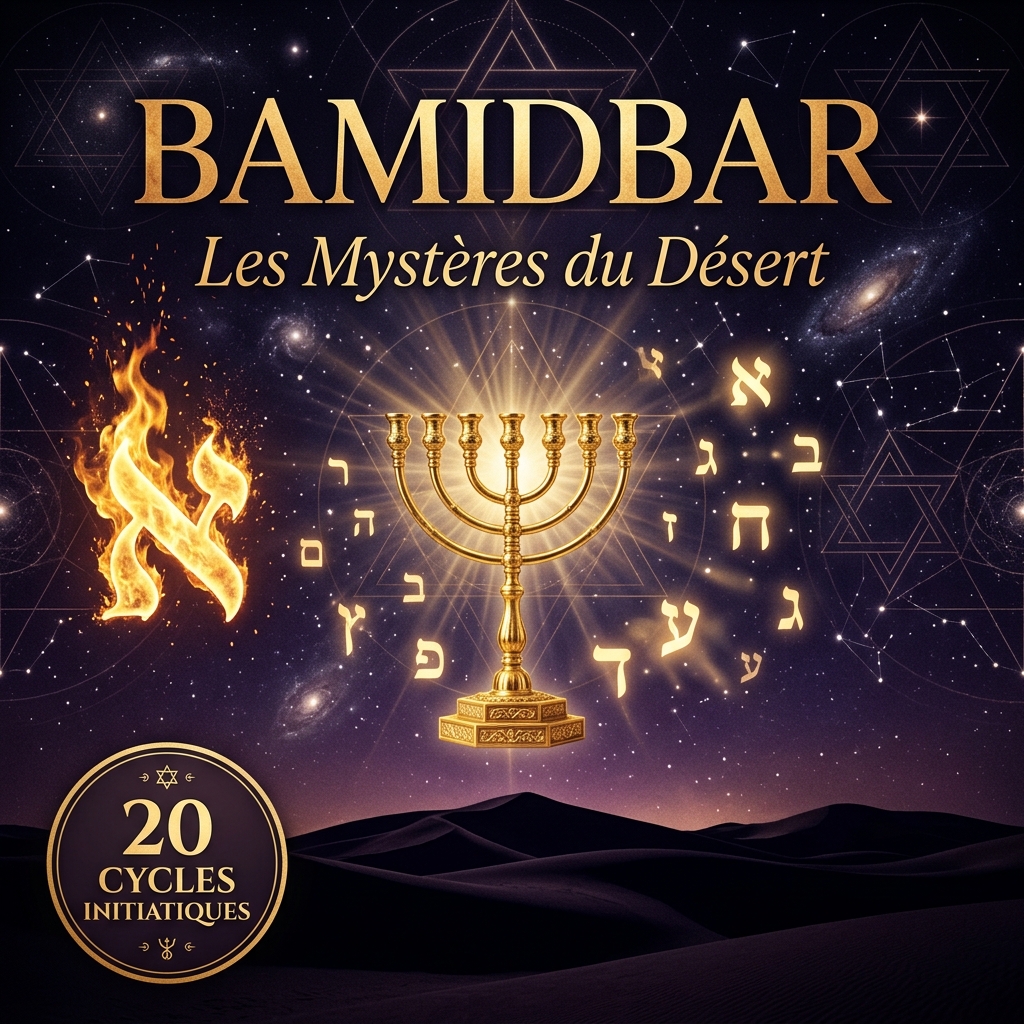
🔥 Bamidbar — Mysteries of the Desert
4 modules · 20 initiatory cycles
The Census — The Emergence of Divine Individuality
Why does God count each soul?
🎯 Understand that the census is a spiritual technology for awakening unique identity.
✨ Free Access — Opening LessonRabbi Nachman of Breslev teaches with unflinching precision: the Torah cannot truly be understood and acquired as long as the absolute individuality of each soul has not been fully manifested. It is imperative to firmly establish this individual identity before being able to unite with others in a common cause. By commanding that the people be counted, God demonstrates how precious each person is to Him — everyone has a unique place and makes an irreplaceable difference in Creation.
This process reveals a profound paradox linked to the nature of the Divine. In its pure essence, holiness transcends the limits of time and space and cannot be numbered or counted. However, to exist in this material world, God established a counting system that allows each person to present themselves and be recognized. It is prophesied that in the World to Come, the number of souls will become incalculable, as they will return to their original state transcending numbers.
On the alchemical level, this count in the desert acted as a repair (Tikoun) made necessary by the sin of the Golden Calf. Sin directly steals a person's sparks of holiness. The census intervened as a means of locating and recovering these lost spiritual sparks to elevate them anew. Finally, counting 'all those who can go out to war' esoterically designates individuals ready to wage the spiritual battle for God — victory is achieved only when individuals, strong in their assumed uniqueness, unite in a common purpose.
⚡ Initiatory Key Points
- 🌟 Each soul is irreplaceable — God counts out of love
- 🔮 The Torah can only be received by an individuated soul
- ⚗️ The census = recovery of lost spiritual sparks (Tikoun)
- ⚔️ 'Those who go out to war' = warriors of spiritual light
- 🌍 In the World to Come, souls will transcend numbers
🧩 Initiatory Trial — Cycle Quiz
According to Rabbi Nachman, why must individual identity precede the collective reception of the Torah?
Which sin did the desert census spiritually repair?
The Sacred Geometry of the Camp and Apocalyptic Numbers
The Cosmic Mandala of the 12 Tribes
🎯 Decode the geometric arrangement of the camp as a prototype of the heavenly Jerusalem.
Each tribe had radically different characteristics — size, position, its own nature — and was distinguished by its own banner with tribal colors. Yet despite these fundamental differences, all tribes were unified by their attachment to the One God, revealing divine Unity through human diversity. The spatial arrangement also concealed a cosmic and temporal dimension: the four encampments represent the twelve months divided into four seasons, and the twelve hours of day divided into four quarters.
The tribes camping in the East — facing the rising sun — corresponded to the first quarter of the day and the season of liberation (spring), marking the spiritual awakening that draws one closer to the Creator from morning. The number 12 is the numerical seal of the chosen people throughout biblical eschatology. This arrangement is but the shadow of a superior cosmic reality: the New Jerusalem has exactly twelve gates bearing the names of the twelve tribes. The 144,000 sealed of Revelation are precisely 12,000 elect from each of the twelve tribes.
The numerology of numbers 3, 4, 7, 10, 12, 40, and 70 structures the Apocalypse from the foundations of Bamidbar: 4 is the number of the visible world, associated with the four winds and four corners of the earth; 7 is the seal of the divine covenant, synthesis of 3 (fullness of God) and 4 (created world).
⚡ Initiatory Key Points
- 🏕️ Tabernacle at center = absolute divine axis
- 🌅 East (Judah) = spiritual dawn, start of redemption
- 🔯 12 tribes × 12,000 = 144,000 sealed of Revelation
- 4️⃣ Number 4 = visible world and divine judgment
- 7️⃣ Number 7 = God (3) + world (4) = perfect covenant
- 🕌 Camp geometry = proto-celestial Jerusalem
🧩 Initiatory Trial — Cycle Quiz
Which tribe camped to the East of the Tabernacle, and what esoteric significance did this have?
Ethio-Hebrew Exegesis — The Forgotten Texts
The Kebra Nagast and the Ethiopian Talmud
🎯 Explore the traditions of Ethiopian Hebrews for a non-Eurocentric reading of Bamidbar.
This cycle drastically broadens our spiritual spectrum by exploring the age-old traditions of Ethiopian Hebrews (the Beta-Israel or Falashas, whose root 'fellese' means 'to emigrate'), Black Hebrews, and progressive Rastafari disciples. These communities possess their own written testimony, preserving ancient religious, metaphysical, and spiritual literature that often predates European commentaries.
At the heart of this exegesis, we reconstruct what our matrix designates as the 'Ethiopian Talmud.' Among these forgotten sacred texts:
• The Kebra Nagast (The Glory of Kings) — the story of the Queen of Sheba and her only son Menelik
• The Lefafa Sedeq (The Bandlet of Righteousness)
• The Book of Jubilees (Kufale or Little Genesis) and the Book of Enoch (Ethiopian Henok)
• The Gadla Adam (The Conflict of Adam) and the wisdom of ancient Egyptian mysteries
To truly penetrate the mysteries of the Torah (called 'Orit' in this tradition), this exegesis demands immersion in the biblical languages of the Hamito-Semitic family: Ge'ez, Tigrinya, archaic Amharic, Aramaic, Sabaean, Assyrian, and hieroglyphics. The goal is to reconstruct the revelations of the desert through this original African wisdom, revealing a profoundly neglected face of Hebrew spiritual history.
⚡ Initiatory Key Points
- 📖 Torah = 'Orit' in the Ethiopian tradition
- 👑 Kebra Nagast = The divine legitimacy of Ethiopia
- ✍️ Ge'ez = liturgical language of Ethiopian Hebrews
- 🌍 Beta-Israel = Falashas, the 'separated' who guard the sources
- 📚 Book of Enoch — preserved in its entirety in Ethiopia only
- 🔭 Non-Eurocentric exegesis = hidden angles of the sacred text
🧩 Initiatory Trial — Cycle Quiz
What is the Torah called in the Ethiopian Hebrew tradition?
The Mystery of the Sotah and the Waters of Bitterness
The Sacrifice of the Divine Name for Peace
🎯 Understand how erasing the sacred Name in water is the Creator's ultimate sacrifice.
The priest inscribes curses containing the sacred Name of God on a scroll, then erases it in the water. What God accomplishes here is extraordinary: He accepts that His ineffable Name be erased from this world to restore peace and harmony (Shalom Bayit) between a husband and wife — the Creator's ultimate sacrifice to protect the marital covenant.
The dust taken from the floor of the Tabernacle corresponds to the sefirah of Malkhut (Royalty) — the lowest divine dimension interacting with our world. The Sotah is tested by Malkhut: if innocent, Malkhut blesses and makes her fertile; if guilty, Malkhut executes the punishment. Each element possesses a dual power activated according to human actions.
The bitter waters of the Sotah are an allegory of Exile. These waters represent the sufferings of the Jewish people through their exiles. If the woman is innocent, these sufferings bring her fertility and growth. The mystery goes further: many sublime texts from past generations have disappeared because heretical texts were circulating. Just as God's Name is erased to restore peace, these books of Torah 'disappeared' to bring about the destruction of heretical books — restoring peace between God and His people.
⚡ Initiatory Key Points
- ✡️ God erases His own Name to protect conjugal peace
- 🌹 Malkhut = the royal divine that distributes blessing or judgment
- 💧 Bitter waters = the fire of Exile that purifies the innocent soul
- 📕 Heretical texts destroyed along with the sacrificed sacred books
- ⚖️ The Priest = intermediary between Rigor and Mercy
- 🌱 Innocent woman → amplified fertility after the ordeal
🧩 Initiatory Trial — Cycle Quiz
What exceptional sacrifice does God accomplish in the Sotah ritual?
The Nazirite Vow — Hair, Wine and Priestly Blessing
ANI — The Mystical Vessel of Blessing
🎯 Understand how the Nazirite vow prepares the soul to receive the Priestly Blessing.
The hair left to grow symbolizes Keter, the Crown — the supreme spiritual level surpassing even conscious intellect. Wine itself is a formidable instrument: 'TiRoSh' (תירוש) is directly linked to the root 'RoSh' (ראש), meaning 'the Head.' Tradition teaches that if one is worthy, TiRoSh becomes RoSh — wine elevating consciousness toward transcendent intellects. But drunk unworthily, it lowers and corrupts.
This elevation opens the way to the Priestly Blessing (Birkat Kohanim), received in a mystical vessel called ANI (I, Me). This Hebrew word is composed of the letters Alef, Nun, and Yud. The letter Alef represents the Tzaddik (the Righteous); Yud corresponds to Thought; Nun corresponds to Speech. Thus, it is by perfectly uniting thought and speech — especially in concentrated prayer — that a human being forms the ANI vessel capable of capturing and retaining divine blessings.
Mastery of earthly passions (the Nazirite's path) combined with perfect alignment of intellect and speech constitutes the indispensable spiritual technology for attracting divine abundance. This is not asceticism for its own sake: it is the preparation of the vessel to receive the light.
⚡ Initiatory Key Points
- 👑 Keter = level beyond intellect, symbolized by hair
- 🍷 TiRoSh → RoSh: wine elevates or lowers according to dignity
- 🙏 ANI = Alef (Tzaddik) + Nun (Speech) + Yud (Thought)
- 🌟 Thought-speech union = vessel for the Priestly Blessing
- ⚗️ The Nazirite transcends matter, not through punishment but ascension
- ✋ Birkat Kohanim = the most powerful blessing in the Torah
🧩 Initiatory Trial — Cycle Quiz
What is the mystical vessel 'ANI' in the Priestly Blessing?
The Menorah — The Tree of Light and the 7 Shepherds
The Seven Lamps and the Seven Mystical Shepherds
🎯 Decode the Menorah as a spiritual technology for diffusing divine light.
The seven lamps represent the seven mystical shepherds of humanity who channeled Divinity into this world: Abraham, Isaac, Jacob, Moses, Aaron, Joseph, and David. Within this matrix, Moses embodies the central lamp — the true Tzaddik toward whom the six other lamps incline. The injunction 'Behaalotecha' (When you raise up the lamps) reveals the Tzaddik's mystical capacity to elevate all fallen souls. The verse states that the light goes 'from its base to its flowers' — esoterically, the Tzaddik's light reaches the lowest levels, most mired in matter, to make them rise and bloom in holiness.
On the level of human psyche, the teachings reveal that each person's head is a reflection of the Menorah: the seven orifices of your head (two eyes, two ears, two nostrils, one mouth) are your seven personal lamps. The initiatory work consists of sanctifying these lamps: keeping the mouth from lies, closing the eyes to evil, opening the ears to wisdom.
⚡ Initiatory Key Points
- 🥇 Gold beaten from one piece = fundamental unity of all rectifications
- 🕎 7 lamps = 7 shepherds: Abraham, Isaac, Jacob, Moses, Aaron, Joseph, David
- 💡 Moses = central lamp, Tzaddik who elevates the other 6
- 👁️ 7 orifices of the head = 7 personal lamps of each human
- 🌸 'From base to flowers' = light descending to the abyss to elevate
- ✨ Behaalotecha = 'when you raise up' — mystery of spiritual ascension
🧩 Initiatory Trial — Cycle Quiz
Who are the seven mystical shepherds of humanity symbolized by the Menorah's seven lamps?
The Silver Trumpets — Hatzotzrot and the Signals of the Soul
Vibratory Frequencies and the Call to Awakening
🎯 Understand the silver trumpets as spiritual vibratory frequencies designed to awaken the soul.
On the material level, these trumpets had precise functions: to assemble the people, announce the dismantling of the camp, call men to arms during war, and commemorate offerings on feast days. However, in the esoteric matrix according to the Likutey Halakhot, these sounds are not mere auditory signals. Each sounding emits specific vibratory frequencies that act as true 'celestial allusions.'
The ultimate goal of these sound waves is to pierce the layers of material illusions to reach the soul. These vibrations are a 'call to awakening' to pull the human being out of spiritual torpor. Each note contains a secret indication, a frequency designed to encourage the person to begin their return to God (Teshuva).
The Torah specifies that on feast days, these trumpets must resound during sacrifices to serve as a 'remembrance' before God. Esotericism reveals that this remembrance is twofold: it is a call to attract Divine Providence, and simultaneously a means of engraving in human memory the remembrance of the World to Come. The pure sound of silver recalls, amid earthly festivities, the eternal purpose of existence.
⚡ Initiatory Key Points
- 🥈 Hammered silver from one block = unity of the divine Source
- 📯 2 trumpets = gathering signal AND journey signal
- 🔊 Each sounding = vibratory frequency targeting a layer of consciousness
- 🔄 Teshuva = the return to God triggered by the sound frequency
- 🌅 Sound of Remembrance = recall of eternity at the heart of the earthly feast
- ⚔️ War sounding = mobilization of spiritual forces against darkness
🧩 Initiatory Trial — Cycle Quiz
What is the ultimate esoteric purpose of the silver trumpet soundings according to the Likutey Halakhot?
Eldad, Medad and the Prophecy of the End of Times
Gog and Magog — The Cosmic War Announced in the Camp
🎯 Understand why two elders who stayed behind received the most powerful apocalyptic prophecy.
But what were they prophesying with such fervor in the midst of the camp? The sage Rav Nahman (Sanhedrin 17a) teaches that they pierced the veil of time to prophesy the ultimate eschatological war: the conflict of Gog and Magog. Other Talmudic traditions specify that they also prophesied the death of Moses and the succession of Joshua.
The prophecy of Gog and Magog is intimately linked to Daat (divine consciousness): the universal establishment of this knowledge of God is precisely the ultimate goal of this cosmic conflict. Through the crushing defeat of Gog and his multitudes, God will manifest His glory before all nations — allowing 'all nations to know that He is the Eternal.' Eldad and Medad thus embody a fundamental esoteric truth: authentic prophecy, rewarding humility, can be neither confined nor censored.
⚡ Initiatory Key Points
- 🙏 Humility = vessel of eternal prophecy
- 🔥 Gog and Magog = cosmic crisis necessary before the messianic era
- 👁️ Revelation of Daat = ultimate result of the apocalyptic war
- 📖 'Among the inscribed' = worthy to proliferate sacred teachings
- ⚖️ Joshua facing Moses = test of the future leader's ego
- 🌍 Prophecy of nations = Truth transcends human borders
🧩 Initiatory Trial — Cycle Quiz
According to Rav Nahman (Sanhedrin 17a), what end-time event were Eldad and Medad prophesying about?
Shelach Lekha — The Spies' Illusion and the Daat
Intellect without Faith — The Fall of the Scholars
🎯 Understand that pure intellect without humility and faith inevitably leads to heresy.
Their terror stemmed not only from physical giants, but from a spiritual inability: they could not understand how to restrict their immense transcendent intellect (Daat) to fit within the more humble parameters of faith that the Promised Land required. Divine intellect requires the humility of the desert to be perceived, and pure intellect that refuses to associate with faith inevitably leads to heresy.
The Hebrew term for 'spies,' meraglem, shares its root with the word regel (foot) — designating those who constantly run in search of material goods, refusing to trust divine Providence. The spies wanted to conquer the land 'naturally,' counting on their own forces.
By bringing back the giant cluster of grapes from the river of Eshkol, they illustrated their own loss of perspective: the grape symbolizes the power to rise to great spiritual levels, but also to trouble and confuse consciousness. By declaring themselves like 'grasshoppers' before the giants, they minimized their spiritual capacities and proved they did not believe God could delight in their action.
⚡ Initiatory Key Points
- 🧠 Dor Deah = Generation of Knowledge — transcendent soul level
- ⚖️ Daat without Malkhut (faith) = intellect cut off from divine reality
- 👣 Meraglem (spies) = same root as regel (foot) = seekers of matter
- 🍇 Eshkol cluster = symbol of the power both to rise AND to be lost
- 🦗 'We are like grasshoppers' = collapse of self-faith
- 💡 Desert humility = condition for receiving transcendent Daat
🧩 Initiatory Trial — Cycle Quiz
Why did the ten spies fail according to the esoteric exegesis of Bamidbar?
The Tzitzit — The Matrix of the 4 Elements
The Cosmic Armor Against the Serpent's Venom
🎯 Decode the Tzitzit as a spiritual technology for mastering 4 elements and protection against immorality.
The Hebrew word for 'garment,' BeGeD, shares the same letters as BoGeD, meaning 'traitor.' One who sins and yields to impulses is a traitor to this sacred matrix — but by attaching oneself to the Tzitzit, the individual binds to the Creator and masters these four elements.
On the moral level, the Tzitzit act as the ultimate remedy against the 'serpent's venom,' which symbolizes immorality. By wearing these fringes, the person connects to the pure nature of the Tzaddikim (the Righteous) who guard the Covenant absolutely, receiving their purified counsel.
The four corners of the garment represent the 'eagle's wings' on which God brought the Israelites out of Egypt. The eagle symbolizes compassion and Daat (superior perception): just as those wings transcended space during the Exodus, the Tzitzit give the soul the power to rise above temporal illusions.
The very making of the Tzitzit is an alchemical code: one thread wraps between five knots, totaling thirty-nine turns — corresponding exactly to the value of the word TaL (dew), attracting a 'dew of blessing.' These five knots recall the first five words of the Shema Israel.
⚡ Initiatory Key Points
- 🧵 4 corners = 4 elements = 4 letters of the Tetragrammaton (YHVH)
- 🐍 'Serpent's venom' = immorality — Tzitzit are the direct antidote
- 🦅 Eagle's wings = capacity to transcend space and time
- 💧 39 wrappings = Hebrew value of TaL (dew) = dew of blessing
- 👔 BeGeD (garment) = same letters as BoGeD (traitor) — warning
- 🔗 Connecting to Tzaddikim through threads = receiving their purified counsel
🧩 Initiatory Trial — Cycle Quiz
What is the esoteric significance of the 39 thread wrappings in the Tzitzit?
The Korah Schism — Intellect Against Truth
The Scholar's Arrogance and the Topography of Gehinnom
🎯 Understand why the highest scholarship without the Tzaddik's humility leads to the abyss.
On the kabbalistic level, Korah's dispute is a war of polarities. As a Levite, Korah was associated with the 'left side,' representing Gevurah (rigor, judgments). Opposite him, Aaron the High Priest embodied the 'right side,' representing Hesed (goodness). Korah's ambition was unnatural: rigor (left hand) sought to dominate goodness (right hand), breaking divine harmony.
The consequence was a literal fracture of reality: the earth opened its mouth to swallow him. But esotericism descends even lower, into the mystical topography of Gehinnom: every 30 days, at Rosh Hodesh (New Moon), the rebels feel remorse. In the abyss of Gehinnom, they proclaim: 'Moses and his Torah are true, and we are liars!'
The rectification of this terrible sin comes through giving charity and tithes. When we give charity, we unite the left hand (rigor) with the right hand (goodness) — neutralizing arrogance and restoring Unity in the world.
⚡ Initiatory Key Points
- 📚 Lamdan = great scholar, but without Tzaddik's virtue = spiritual danger
- ⬅️ Korah = Gevurah (left hand) seeking to usurp Hesed (right hand)
- 🌋 Earth opens = cosmic fracture caused by intellectual arrogance
- 🔄 Every 30 days: rebels cry 'Moses is true!'
- 💝 Charity = union of two hands = rectification of Korah's schism
- 🙏 Arrogance = spiritual equivalent of idolatry
🧩 Initiatory Trial — Cycle Quiz
What is the esoteric remedy prescribed to repair the cosmic schism caused by Korah?
The Supreme Enigma — The Red Heifer (Chukat)
The Paradox that Purifies the Impure and Defiles the Pure
🎯 Understand how the Chok (irrational divine decree) teaches us absolute intellectual humility.
The absolute paradox is this: its ashes purify the one who is ritually impure (particularly through contact with a corpse), but simultaneously, and incomprehensibly, they render impure whoever deals with its preparation. The Mishnah (Parah 4:4) confirms this explicitly.
Deep symbolism according to the Zohar (III, 180b): The reddish color represents the dimension of Gevurah (Rigor or Judgments). The purifying power of the Red Heifer comes paradoxically from this Rigor — by accepting this irrational decree through prayer, man softens severe judgments. The requirement that the heifer never bore a yoke symbolizes absolute faith in God, totally freed from the yoke of idolatrous beliefs. The female sex: Rabbi Aibo explains that the Red Heifer comes to atone for the sin of the Golden Calf — the mother repairs the son's fault.
The deep purpose of this Mitzvah is to rectify the death introduced by Adam's sin, who wanted to understand everything, exceeding the limits of what he was permitted to probe. The Red Heifer ritual teaches us above all to cancel our intellectual arrogance and accept that certain divine mysteries completely exceed our limited intellect.
⚡ Initiatory Key Points
- 🔴 Reddish color = Gevurah (divine Rigor) that paradoxically purifies
- 🐄 Heifer never bearing a yoke = faith free of all idolatry
- ♀️ Female heifer = mother expiates the son's fault (Golden Calf)
- 🧠 Chok = irrational decree = lesson of supreme intellectual humility
- ☠️ The ritual rectifies the death introduced by Adam's sin
- 😊 Purifying the impure WHILE defiling the pure = God's intentional paradox
🧩 Initiatory Trial — Cycle Quiz
What is the central paradox of the Red Heifer (Parah Adumah) ritual?
Mei Meribah — Striking the Rock and the Hidden Waters
When Anger Breaks the Channel of Grace
🎯 Understand how absolute humility is the only key to receiving wisdom as a gift.
Water, in Kabbalah, refers to the Torah and divine wisdom. Facing the aggressive demands of the people, Moses momentarily lost his Daat (superior consciousness) by yielding to anger. Instead of supplicating God and speaking gently to the rock, he demanded action by force. Forcing things is spiritually equivalent to a form of theft — seeking to snatch what must be granted by divine grace.
The Rock should not be seen as a mere mineral, but as the 'Superior Heart' — the very source of Torah teachings. To attract new revelations from this Superior Heart, one cannot use force or intellectual coercion, but must pour out one's own heart in humble prayer.
This is the supreme lesson of this cycle: if a person makes themselves like a desert over which everyone can walk, the knowledge of the Torah is then granted to them as a gift (Matana). Only through the most radical humility, totally annulling oneself like desert sand, does one become a vessel capable of receiving the water of eternal wisdom. Anger and egotistic study block the channels of grace — the humility of the desert opens them wide.
⚡ Initiatory Key Points
- 💧 Water = Torah and divine wisdom in Kabbalah
- 🤜 Striking = forcing = stealing what must be granted by grace
- 🗣️ Speaking = praying = humility = the only way to receive
- 🪨 The Rock = the 'Superior Heart' source of new revelations
- 🏜️ 'Becoming a desert' = absolute humility = Torah given as gift
- 😡 Anger = loss of Daat = blocking the channel of wisdom
🧩 Initiatory Trial — Cycle Quiz
What is the supreme spiritual condition for receiving the knowledge of the Torah as a divine gift?
The Bronze Serpent — The Elevated Gaze
The Technology of the Gaze: Transforming Poison into Elixir
🎯 Understand that spiritual salvation comes not from a magical object but from elevating consciousness toward the Creator.
The Mishnah (Rosh Hashana 3:8) states with absolute clarity: it is not the metal of the serpent that healed. The miraculous healing occurred only when the Israelites directed their thoughts upward and turned their hearts toward God. Conversely, if they failed to do so, they perished.
On the esoteric level, this act of raising one's eyes acts as the absolute antidote against attachment to earthly and material illusions. Looking at the bronze serpent on a pole is a spiritual technology: by elevating one's gaze above earthly limits toward the Creator, one transforms the poisonous venom of material illusions into a true elixir of life.
Moses' elevation of the bronze serpent is a 'symbolic-typological' act — designed to prefigure future spiritual realities. It is one of the most remarkable archetypes of the Old Testament, illustrating how punishment itself can be transformed into an instrument of salvation. Just as the bronze serpent was fashioned in the image of the fiery serpents but without their venom, the elevated standard represents the paradox of a neutralized evil transformed into a remedy — the simple act of faith that transforms death into life.
⚡ Initiatory Key Points
- 👁️ Looking = an act of consciousness, not magic — directing the heart to God
- 🐍 Bronze serpent = image of venom WITHOUT the venom = neutralized evil
- ⬆️ Raising the gaze = transcending attachment to earthly illusions
- 💊 Poison transformed into elixir = technology of pure faith
- 📜 Mishnah (Rosh Hashana 3:8): Without intention toward God, the gaze does not save
- 🔮 Symbolic-typological act = prefigures future spiritual realities
🧩 Initiatory Trial — Cycle Quiz
According to the Mishnah (Rosh Hashana 3:8), what actually enabled healing in the episode of the bronze serpent?
Balak and the Prophetic Antithesis — The Occult War
Bilaam — Perverted Intellect as a Cosmic Weapon
🎯 Understand the invisible war between the Daat of holiness (Moses) and the Daat of impurity (Bilaam).
Balak, the king of Moab, esoterically means 'LoKek' (to lick) — he represents the wild beast that denies Divine Providence, believes only in nature, and seeks to 'lick the blood of the Jews.' Balak was a great sorcerer, but he understood that his natural magic was completely powerless against a people whose strength lies in prayer. He therefore calls upon the only weapon capable of competing: Bilaam.
If Moses is the summit of Daat (God-consciousness) on the side of holiness, Bilaam is his exact reflection, the personification of the Daat of impurity. The name BiLAaM (בלעם) comes from BoLeA (to swallow or engulf) — his occult purpose was to engulf the entire nation. Just as Moses' strength lay in his mouth (to reveal the light of the Torah), Bilaam's power also lay in his mouth (to pronounce curses). The teachings reveal that Bilaam exhaled from his mouth a poisoned air of immorality.
The greatest threat comes not from brute force, but from perverted intellect. The kabbalistic matrix encodes this conflict in their names: MoSheH RaBEiNu (Moses our teacher) = 613 (Taryag) = the 613 commandments of the Torah. Bilaam's name is a malicious parody: Bet and Mem = first and last letters of a perverted Torah; Ayin (70) = the 70 nations perverting the 70 faces of the Torah.
⚡ Initiatory Key Points
- 👁️ BaLaK = LoKek (to lick) = wild beast denying Providence
- 😈 BiLAaM = BoLeA (to engulf) = Daat of impurity opposing Moses
- 👄 Moses's AND Bilaam's power = in the mouth (Torah vs curses)
- 🔢 Moses = 613 (Taryag) = all Torah Mitzvot
- ☠️ Bilaam = malicious parody of Torah's letters and numbers
- 💡 The true threat = the corrupt scholar, not the brutal soldier
🧩 Initiatory Trial — Cycle Quiz
What is the kabbalistic meaning of the name BiLAaM (בלעם) and what was his ultimate purpose?
The Speaking Donkey — The Eye Opened
When Pure Instinct Sees More Clearly than Perverted Intellect
🎯 Understand the cosmic humiliation of perverted intellect through the mystery of the letter Ayin.
The esoteric secret lies in the Hebrew letter Ayin (עין), meaning 'the eye,' with a numerical value of 70. This number 70 symbolizes the 70 nations of the material world. Bilaam's eye was completely blinded by his thirst for power and his passions, preventing him from perceiving the most obvious spiritual reality. The letter Ayin itself teaches us that perverted intellect, like Bilaam, uses the eye for the interests of the 70 material nations — thereby losing vision of the spiritual world.
When God opens the donkey's mouth, the Targum (translated by Tina) reveals that her words mean: 'Have you ever taught me?' This stinging reply is a direct attack on Bilaam's supposed scholarship. It demonstrates that human intellect, when perverted by impurity, becomes inferior to the clairvoyance and pure instinct of a simple animal.
The donkey sees the angel before the prophet — thus proving the nullity of his spiritual vision. Are we not ourselves sometimes like Bilaam? Riding our 'donkey' (our daily life and simple acts) which guides us, but which we mistreat when it resists our errors, instead of understanding that it sees more clearly than we do what is blocking us.
⚡ Initiatory Key Points
- 👁️ Ayin (ע) = the eye = value 70 = the 70 nations = material blindness
- 🫏 The donkey sees the angel = pure instinct transcends perverted intellect
- 💬 'Have you ever taught me?' = cosmic humiliation of the false prophet
- 🔍 Immorality blinds = one no longer sees what is spiritually obvious
- 🌙 Bilaam = sees only the 70 nations = loses vision of the One
- 🪞 Mirror for us: our daily 'donkey' sometimes sees better than we do
🧩 Initiatory Trial — Cycle Quiz
What is the esoteric meaning of the letter Ayin (70) in the episode of Bilaam's donkey?
Apocalyptic Poetry — The 4 Oracles of Bilaam
A Star Rises from Jacob — The Vision of the Messiah
🎯 Decode the four oracles of Bilaam as the oldest messianic apocalyptic texts.
The fourfold structure is striking: each time the frustrated Balak repositions Bilaam to show him the camp from a different angle hoping for a curse, the divine blessing intensifies. This fourfold repetition symbolizes apocalyptic certainty and fullness.
In his first oracle, Bilaam confesses his absolute powerlessness: 'How shall I curse whom God has not cursed?' In the second, the spiritual protection is declared: no enchantment or divination can prevail against God's people. In the third, Bilaam exclaims: 'How goodly are your tents, O Jacob!' — prophesying the invincible strength of the chosen people.
It is the fourth oracle that becomes pure apocalypse. The furious King Balak dismisses Bilaam — but the prophet unveils the final eschatological horizon: 'A star rises from Jacob, a scepter arises from Israel.' This royal scepter is destined to break hostile powers at the end of time. Bilaam's poetry encompasses the prophetic destiny of seven nations (Moab, Edom, Amalek, the Kenites, Asshur, Kittim, and Eber) — sketching the apocalypse of Israel's ultimate struggles among the nations.
⚡ Initiatory Key Points
- ✡️ 4 oracles = apocalyptic structure of growing certainty
- ⭐ 'A star rises from Jacob' = announcement of the Messiah's coming
- 🏕️ 'How goodly are your tents, Jacob!' = synagogues and houses of study
- 🛡️ 2nd oracle: no magic can prevail against Israel
- 🌍 7 prophesied nations = eschatological destiny of all humanity
- 🖤 Bilaam forced to bless = God transforms evil into a tool of revelation
🧩 Initiatory Trial — Cycle Quiz
What crucial messianic announcement does Bilaam pronounce in his fourth oracle?
Phinehas — The Spear of Zeal and the Covenant of Peace
How an Act of Pure Zeal Generates Eternal Peace
🎯 Understand how pure zeal for the Divine Will, without ego, transforms a person into a channel of eternity.
By publicly uniting with Cozbi, Zimri had deeply corrupted the covenant and caused sparks of holiness to fall into the forces of impurity. Phinehas's action was not merely a physical attack — esoterically, he formulated a 'prayer of judgment' (VeIPaLeL) of extreme power, forcing the forces of impurity to 'vomit up' the sacred sparks they had swallowed.
The alchemical secret of the Spear (Romach): To accomplish this feat, Phinehas drew on the Ruach Mem (spirit of forty), echoing Moses's forty days on Sinai. By adding this letter Mem (value 40) to his own identity, Phinehas elevated his numerical level to 248 — the exact value of the word Romach (the spear). He literally became the spear of divine justice.
This act of pure zeal protected the divine Name of 72 letters — instantly sealing the breach that public sin had opened. The paradox of the reward: a bloody act rewarded with Peace. But esotericism explains: by eliminating the instigator of evil with pure zeal and not out of hatred, Phinehas attained the quality of love associated with Abraham, and love is synonymous with peace. His ultimate reward transcends the limits of human condition: Phinehas was granted eternal life. He never died — he became the prophet Elijah.
⚡ Initiatory Key Points
- 🗡️ Spear (Romach) = 248 = numerical value of Phinehas + letter Mem (40)
- 🔢 Mem (40) = the spirit of Moses's 40 days on Sinai
- 🔐 Pure zeal = closing the breach in the divine Name of 72 letters
- ☮️ Paradox: violent act → reward of the Covenant of Peace
- ♾️ 'Prayer of judgment' (VeIPaLeL) = liberation of captive sparks
- 🔥 Phinehas = the prophet Elijah — granted eternal life for pure zeal
🧩 Initiatory Trial — Cycle Quiz
How did Phinehas attain the numerical value of 248 (Romach = the spear)?
The Daughters of Zelophehad — The Wheel of Inheritance
Gilgul — Reincarnation in Service of Eternity
🎯 Understand how inheritance laws and the Levirate reveal the mysteries of reincarnation (Gilgul).
The Talmud teaches that these women were of great wisdom, equal merit, fervent students of the Torah, and of absolute righteousness. Just as their ancestor Joseph loved the Holy Land so much that he made his brothers swear to bring his bones there, these women ardently desired to attach themselves to the holiness of the Land. They proved their intellectual acuity by raising the question of their inheritance at the exact moment Moses was explaining the law of levirate marriage — skillfully using this law as a legal analogy.
In the kabbalistic dimension, material inheritance is the reflection of a spiritual transmission. By inheriting what their parents left, children continue the work of their parents and connect future generations to past ones — a repair process reaching back to Adam's sin. Leaving an inheritance allows the Tikkun HaKlali (the General Remedy) to be accomplished.
The initiatory heart of this cycle: the connection between female inheritance and the Levirate law (Ibum). The Zohar reveals that levirate marriage conceals the vertiginous secret of reincarnation (Gilgul) — a man who dies childless reincarnates as the son of his former wife and his living brother. This divine mechanism guarantees that a soul's light never extinguishes in the fabric of the universe.
⚡ Initiatory Key Points
- 👩 5 daughters of Zelophehad = wisdom, merit and feminine Torah
- 🌱 Material inheritance = reflection of inter-generational spiritual transmission
- 🔗 Levirate (Ibum) = esoteric technology of kabbalistic repair
- ♻️ Gilgul = reincarnation: the soul continues its work in a new body
- 💡 Tikkun HaKlali = General Remedy that children accomplish for their parents
- ✨ Soul's light = NEVER extinguishes in the fabric of the universe
🧩 Initiatory Trial — Cycle Quiz
What vertiginous esoteric secret does the Zohar reveal through the levirate marriage law (Ibum)?
Masei — The 42 Stages of the Soul Toward Eternity
The Alchemical Map of Human Consciousness
🎯 Understand that the 42 desert encampments are the initiatory map of every human soul crossing its own deserts.
The journey begins in Egypt (Mitzrayim), a place representing absolute material constriction (MeTzar = narrowness). The goal of these 42 stages: to make each soul cross all dimensions of this narrowness to bring it to the Promised Land, symbol of liberation where the being breaks the barriers of time to enter eternity.
Rabbi Nachman's teachings reveal that travel and exile are the spiritual rectifications (Tikkun) of damaged faith. Idolatry and lack of faith cause exile of the Divine Presence — but by traveling with absolute faith that God will provide everywhere, the individual rectifies faith and ends the Shekhinah's exile.
A sublime linguistic secret: the word HaLaKhah (Jewish law) shares its root with HaLiKhah (walking, traveling). The physical travels in the desert aimed to seek, clarify, and elevate divine laws hidden in darkness. Each step clarifies the paths that allow the soul to draw closer to God.
The Professor's Conclusion: This 20th cycle teaches us that each trial, each wandering, each 'desert' we cross in our existence is a programmed stage of our own Masei. By walking with faith, we transform our personal exiles into living Torah, until reaching our own Promised Land.
⚡ Initiatory Key Points
- 🗺️ 42 stages = exact cartography of the soul's ascension
- 🇪🇬 Egypt (Mitzrayim/MeTzar) = material constriction = starting point
- ✈️ Travel = Tikkun of lack of faith = rectification in motion
- 🐍 Serpents and scorpions = Klipot (inner fears) to be crossed
- ⚖️ HaLaKhah / HaLiKhah = Law and walking share the same root
- 🌟 Each exile transformed by faith → becomes eternal Torah
🧩 Initiatory Trial — Cycle Quiz
What supreme linguistic secret unites the concept of 'Jewish law' (HaLaKhah) with the 42 desert stages?
According to Rabbi Nachman, why must the soul pass through these 42 stages of wandering and exile?
You have traversed the 42 stages of Masei. Your Promised Land is near.
Podcasts — Esoteric Bamidbar
Generated via NotebookLM · Immersive music · 15–20 min · Perfect for meditation
Want unlimited Tina AI access on all courses?
🔮 See our plans →