🖐️ Chiromancy — The Art of Reading Hands
4 modules · 10 foundational lessons
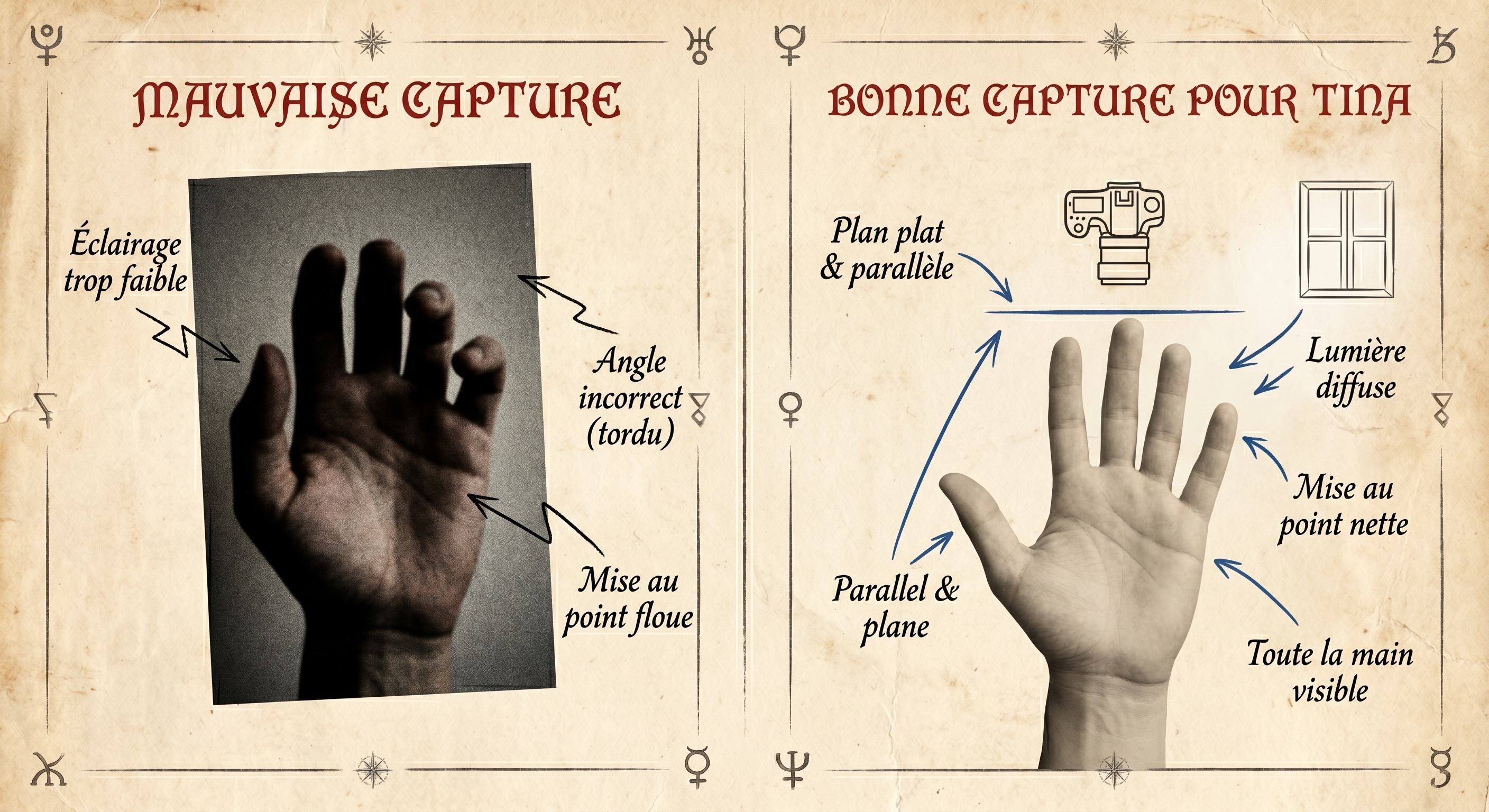
📸 Tina Vision : Envoyez une photo de votre main dans le chat — Tina l'analyse selon la méthode classique de Desbarrolles.
Comment photographier votre main pour Tina
Suivez ce guide visuel pour obtenir une analyse précise. Une bonne photo change tout.
What is Chiromancy?
🎯 Understand the origins, dual nature, and scientific foundations of hand reading.
✨ GratuitIn the 19th century, two French figures transformed chiromancy into a structured and coherent system. Captain Casimir Stanislas d'Arpentigny, in La Science de la Main (1843), founded chirognomy — the study of the hand's external form: its general morphology, finger type, and thumb quality. His genius lay in establishing a systematic correlation between hand shape and temperament. Adolphe Desbarrolles, in Les Mystères de la Main (1859), completed this work with chiromancy proper — the reading of lines, mounts, and signs imprinted in the palm. His physiological explanation is remarkable: the lines of the hand result from the ceaseless passage of 'vital fluid' from the nerve endings to the brain, leaving on the palm a trace of nervous system activity.
This dual approach — chirognomy (form) and chiromancy (lines) — forms the foundation of the classical method you are about to learn. Chirognomy speaks of innate character and deep tendencies; chiromancy reveals events, influences, and key moments of existence. Together, they offer a complete and nuanced reading. It is this complementarity, rigorously codified by Desbarrolles and d'Arpentigny, that Tina has integrated to guide you in the interpretation of your own hands.
⚡ Key Points
- 🖐️ Chiromancy rests on two complementary branches: chirognomy (form) and chiromancy (lines)
- 📜 The oldest hand-reading texts date to 2000 BC in India
- 🧬 Desbarrolles explains lines through nerve physiology — not magic
- 🎓 D'Arpentigny founded chirognomy in 1843; Desbarrolles chiromancy in 1859
- ⚠️ Chiromancy indicates tendencies, not absolute certainties
🧩 Quiz rapide
What is the difference between chirognomy and chiromancy?
Right Hand, Left Hand
🎯 Master the classical doctrine on the role of each hand and know which hand to read first.
✨ GratuitThe left hand — the natal hand — is the one you are born with. It reveals the innate dispositions received at birth: natural aptitudes, deep character tendencies, the raw potential of the individual. It shows what nature planned. This hand contains the original blueprint of the being: gifts and constitutional weaknesses, hereditary predispositions. It is the hand of pre-written destiny.
The right hand — the active hand — is the one that evolves over the course of a life. It records what the individual has done with their innate potential: acquired habits, choices made, experiences undergone. It shows the transformation of the being through their own effort. A weak line on the left can become strong on the right if the individual has developed the corresponding quality. Conversely, a fine potential on the left can be thwarted on the right by unfavourable circumstances or poor choices.
In the classical tradition, one begins with the dominant hand — the one with which one writes — for the main reading. The comparison between the two hands is then essential: the differences between the left (natal) and the right (acquired) tell the story of a life. Note: this rule applies to right-handed people. For left-handed people, the left hand is the active one and the right is natal. When Tina analyses a photo of a hand, she will always ask you to specify your dominant hand.
⚡ Key Points
- 👈 Left hand = innate gifts, birth potential, pre-written destiny
- 👉 Right hand = personal evolution, acquired traits, life choices
- ✍️ For right-handers: read the right first, compare with the left
- 🔄 Differences between the two hands reveal personal transformation
- 📸 Always specify your dominant hand when submitting a hand for analysis
🧩 Quiz rapide
According to classical tradition, what does the right hand reveal in a right-handed person?
The Map of the Hand
🎯 Learn to name and locate all anatomical elements of the palm: mounts, main lines, and zones.
✨ GratuitThe Mounts are the fleshy reliefs located at the base of the fingers and on the edges of the palm. There are seven main ones: the Mount of Jupiter (under the index finger) — ambition, leadership, pride; the Mount of Saturn (under the middle finger) — prudence, gravity, fate; the Mount of Apollo (under the ring finger) — success in the arts, glory, beauty; the Mount of Mercury (under the little finger) — eloquence, commerce, science; the Upper Mount of Mars (under Mercury, on the edge of the hand) — resistance, endurance, moral courage; the Mount of the Moon (opposite edge, between Mars and the wrist) — imagination, travel, poetry, mystery; the Mount of Venus (base of the thumb, encircled by the life line) — love, passion, sensuality, vitality. Finally, between the Upper and Lower Mounts of Mars lies the Plain of Mars, whose hollow or elevation also carries meaning.
The three main lines are: the Line of Life, which arcs around the Mount of Venus from the space between thumb and index finger to the wrist; the Line of Head, which starts from the same point and crosses the palm horizontally; and the Line of Heart, the upper line crossing the palm below the finger mounts. To these three chief lines are added the Line of Fate (or Saturn), vertical, rising from the wrist toward the middle finger; the Line of the Sun (or Apollo), rising toward the ring finger; and several secondary lines. Remember: these lines are not set in stone — they evolve with you.
⚡ Key Points
- ⛰️ 7 main mounts: Jupiter, Saturn, Apollo, Mercury, Mars (x2), Moon, Venus
- 〰️ 3 chief lines: Life, Head, Heart
- 📍 The Line of Life encircles the Mount of Venus — it does NOT measure lifespan
- 🌙 The Mount of the Moon is on the side opposite the thumb — imagination and mystery
- 🪐 Each mount corresponds to a planet and precise symbolic qualities
📸 Tina Vision : Envoyez une photo de votre main ouverte, paume vers la caméra, bien éclairée — Tina identifiera les monts et lignes visibles selon la méthode de Desbarrolles.
🧩 Quiz rapide
Where is the Mount of Venus located on the hand?
The Types of Hands
🎯 Identify the seven major hand families according to d'Arpentigny and Desbarrolles and understand their characterological significance.
🔒 PremiumThe Psychic Hand (pointed fingers) is the rarest and most beautiful according to d'Arpentigny. Long, narrow, with tapering fingers ending in a point and a small, elegant thumb, it characterises the pure idealist, the mystic, the inspired. Its possessors have extraordinary intuition and exquisite sensitivity, but little practical sense. The Artistic Hand (conical fingers) is the most common among artists and society people. Its fingers taper from the middle joint toward a rounded, cone-shaped tip. It combines sensitivity and reason, love of beauty and a sense of reality — it is the hand of many talented musicians, poets, and actors.
The Useful Hand (square fingers) is the hand of practical sense par excellence. Its fingers, of nearly uniform width, end in a square. Order, method, love of truth, honesty — these are its qualities. It is the hand of architects, lawyers, and serious business people. The Necessary Hand (spatulate fingers) is the hand of action and physical energy. Its fingers widen toward the tip in the shape of a spatula. Indispensable to people of the North, as d'Arpentigny humorously puts it, it characterises the adventurer, the athlete, the conqueror. The Philosophical Hand (pronounced knots), Elementary Hand (short rigid fingers), and Mixed Hands complete this classification you will learn to recognise at first glance.
⚡ Key Points
- 🔮 Psychic Hand (pointed): idealism, intuition, little practical sense
- 🎨 Artistic Hand (conical): art, sensitivity, love of beauty
- 📐 Useful Hand (square): order, method, honesty, business sense
- ⚡ Necessary Hand (spatulate): action, physical energy, independence
- 🧠 Philosophical Hand (knotted): reason, logic, analytical thinking
- 🤲 Mixed Hands are the most frequent in reality
🧩 Quiz rapide
What hand is characteristic of the 'Useful' type according to d'Arpentigny?
The Fingers and the Thumb
🎯 Interpret the length, shape, and phalanges of each finger, and the thumb as a revealer of will and reason.
🔒 PremiumThe relative length of the fingers is crucial. An index finger longer than the middle finger indicates an almost tyrannical domineering spirit. A very long little finger denotes exceptional talent for diplomacy or, in an unfavourable character, duplicity. The phalanges of the fingers, three per finger, are read vertically: the first phalanx (nailed) corresponds to intuition and inspiration; the second to logic and reason; the third to material instinct. If one is disproportionate, the corresponding quality will be exacerbated.
The Thumb is, according to all classical masters, the keystone of hand reading. It is not one of the four fingers — it is a separate entity. Its first phalanx reveals the strength of Will: long and round, it announces a powerful and healthy will; short, a deficient or capricious will; 'clubbed' (broad and round like a marble), it indicates in classical tradition uncontrollable violent outbursts. Its second phalanx reveals Reason: long and well-formed, it guarantees that will is guided by logic; thin and short, reason is weak or erratic. The angle the thumb makes with the hand — open toward generosity, closed toward mistrust — completes this essential reading.
⚡ Key Points
- ☝️ Index (Jupiter) = ambition, leadership
- 🖕 Middle (Saturn) = gravity, prudence, fate
- 💍 Ring (Apollo) = art, beauty, glory
- 🤏 Little (Mercury) = eloquence, commerce, science
- 👍 1st phalanx of thumb = Will | 2nd phalanx = Reason
- 📐 Phalanx 1 = intuition | 2 = logic | 3 = material instinct
🧩 Quiz rapide
What does the first (nailed) phalanx of the thumb reveal according to classical tradition?
The Mounts of the Hand
🎯 Understand the meaning of each mount according to its development and the signs it bears.
🔒 PremiumThe Mount of Jupiter, under the index finger, reveals ambition, the desire for leadership, a sense of honour, and religiosity. Well-developed, it announces noble pride and a legitimate aspiration to rise. Excessive, it tips into arrogance and tyranny. The Mount of Saturn, under the middle finger, is often little developed — too developed, it announces a melancholy temperament, prudent to the point of paralysis, obsessed with death and ultimate questions.
The Mount of Apollo (under the ring finger) is that of success in the arts, glory, and fortune. The Mount of Mercury (under the little finger) governs practical intelligence, science, commerce, and medicine. The Mount of Mars (upper: moral resistance, passive courage; lower: aggression, active courage) reveals pugnacity and endurance. The Mount of the Moon — the vast territory on the side opposite the thumb — is that of poets, travellers, and mystics: a very developed Moon can lead to genius or madness, depending on the rest of the hand. Finally, the Mount of Venus — the most expressive of all — reveals the individual's loving power, sensual generosity, and physical vitality.
⚡ Key Points
- ♃ Jupiter: ambition, honour, leadership — excessive: arrogance
- ♄ Saturn: prudence, melancholy, fate — excessive: paralysis through fear
- ☀️ Apollo: artistic success, glory, fortune
- ☿ Mercury: practical intelligence, eloquence, medical sciences
- ♂️ Mars: active courage (lower) and moral resistance (upper)
- 🌙 Moon: imagination, travel, mysticism — excessive: instability
- ♀️ Venus: love, generosity, physical vitality
🧩 Quiz rapide
A very developed Mount of the Moon is associated with which main quality?
The Line of Life
🎯 Learn to read the quality, length, and modifications of the line of life without falling into popular myths.
🔒 PremiumThe Line of Life begins in the space between thumb and index finger and describes an arc around the Mount of Venus to the wrist. Its quality takes precedence over its length. A long, deep, clear, rosy line like a clean furrow in the flesh indicates a robust constitution, vigorous health, great physical resistance. A fine, pale, or chained line (composed of small linked rings) reveals a delicate constitution, fragile health, susceptibility to illness.
Lines of Influence that depart from the Mount of Venus to cut or graze the Line of Life recount the events affecting existence — emotional, familial, or under the influence of a strong third party. Islands on the line indicate periods of frail health. Breaks or cuts signal ruptures in existence — serious illnesses, accidents, or radical changes of life. Branches rising upward are signs of social elevation; downward, of losses. To measure time on the Line of Life, classical tradition divides the line into proportional segments: age 20 is located approximately one-third of the way along the line from its beginning.
⚡ Key Points
- ✅ Myth debunked: short life line ≠ short life
- 💪 Quality of line > length: deep and clear = good vitality
- 🔗 Chained line = delicate constitution, fragile health
- 💔 Island on the line = period of poor health
- ✂️ Break = major event (illness, accident, radical change)
- ⏱️ Age 20 ≈ first third of the line from its start
🧩 Quiz rapide
According to Desbarrolles, what does a short life line actually imply?
Line of Head and Line of Heart
🎯 Read the two lines revealing intelligence and emotional life, their variants, and modifications.
🔒 PremiumThe Line of Head generally starts from the same point as the Line of Life, or very close, between thumb and index, and crosses the palm horizontally. Its course reveals the type of intelligence: a straight line, directed toward the percussion edge of the hand, indicates practical, material, logical intelligence, well grounded in reality — it is the line of business people and engineers. A curved line, sloping downward toward the Mount of the Moon, reveals imaginative, poetic, artistic intelligence, sometimes romantic at the expense of reality. Its length indicates the scope of intellectual interests; its depth, the concentration of the mind.
The Line of Heart crosses the palm in its upper part, below the finger mounts. Its termination is crucial: if it ends below the finger of Jupiter, it indicates a high ideal of love, sentimental demands, and pride; if it ends below Saturn, a calculating love often prone to unhappiness; if it rises between Jupiter and Saturn, this is the happiest position. A long, deep, slightly rosy line announces a warm, faithful, generous heart. A short, pale line reveals a cold, selfish, or unpassionate heart. Islands on the Line of Heart signal romantic disappointments or cardiac fragilities.
⚡ Key Points
- ➡️ Straight Line of Head = practical, material, logical intelligence
- 🌙 Curved Line of Head toward Moon = imagination, poetry, art
- ♃ Line of Heart ending under Jupiter = high, demanding ideal of love
- ♄ Line of Heart under Saturn = calculating or unhappy love
- ❤️ Long, deep Line of Heart = warm, faithful heart
- 🏝️ Island on Line of Heart = romantic disappointment or cardiac fragility
🧩 Quiz rapide
A Line of Head sloping toward the Mount of the Moon indicates what type of intelligence?
Line of Fate and Line of the Sun
🎯 Understand the two great lines of success: the Line of Fate (career, circumstances) and the Line of the Sun (glory, fortune, renown).
🔒 PremiumA line of fate starting directly from the wrist and rising clearly and cleanly to Saturn indicates an individual who built themselves, who became aware of their path early and walked it with constancy. If it begins at the Mount of the Moon, existence depends greatly on others: this is often the line of artists, public figures, those whose success rests on others' approval. Breaks in the line signal career or directional changes. A line that resumes after a break, slightly offset, indicates a successful reorientation.
The Line of the Sun (or Apollo) is the happiest line in the hand. It rises toward the finger of Apollo (the ring finger) and its very existence is a guarantee of success in a brilliant domain — arts, letters, or any publicly valued activity. It can be absent from the hand of a virtuous and hardworking individual without being negative — it simply indicates that public success or notoriety is not part of their path. Short and clear in the upper hand only: success to come or late success. Long and well-drawn from below: early brilliance, a life placed under good auspices.
⚡ Key Points
- 📊 Absent Line of Fate = no particular pre-drawn destiny, life built through circumstances
- 🌟 Origin from wrist = self-made, self-determined destiny
- 🌙 Origin from Mount of Moon = success dependent on others' approval
- ✂️ Break in Line of Fate = career or life direction change
- ☀️ Line of the Sun = guarantee of public success, glory or fortune in the arts
- ⏳ Absent Line of the Sun ≠ unhappy life — simply no public notoriety
🧩 Quiz rapide
What does a Line of Fate originating from the Mount of the Moon mean?
Complete Reading Method
🎯 Learn the classical method of reading a complete hand: order of observation, hierarchy of interpretation, and the art of synthesis.
🔒 PremiumStep 1 — The global first impression: look at the entire hand before analysing it. Its volume, its colour (pale, rosy, reddish), its consistency (supple, hard, soft), its general proportions between palm and fingers. This first impression is often the most accurate and synthetic. Step 2 — The type of hand: apply the chirognomical classification. Psychic, artistic, useful, necessary, philosophical, mixed? This type provides the guiding thread for the entire reading. Step 3 — The thumb: it is the most revealing element of deep character. Will (first phalanx) and Reason (second phalanx): what are their proportions? Step 4 — The mounts: which mounts are most developed? They reveal the dominant energy domains in the individual's life. Step 5 — The three chief lines: Life (vitality), Head (intelligence), Heart (emotions). Step 6 — Secondary lines: Fate, Sun, and other lines present. Step 7 — Signs: stars, crosses, islands, squares, triangles on lines and mounts.
Desbarrolles' golden rule: an isolated indication means nothing. It is the concordance of several indices that creates certainty. Never a single line predicts an event — it is always the whole hand that speaks. When you send a photo of your hand to Tina, she will follow this method in three stages: general form, then mounts, then lines — from the most general to the most precise.
⚡ Key Points
- 🔍 Order: overall impression → hand type → thumb → mounts → lines → signs
- ⚖️ Golden rule: an isolated indication means nothing — look for concordance
- 🖐️ The whole hand speaks — never one line alone is sufficient
- 📸 For image analysis: always specify right/left hand and dominant hand
- 🎯 Start with chirognomy (form) before chiromancy (lines)
- 🔄 Compare both hands: left (natal) vs right (acquired)
🧩 Quiz rapide
According to Desbarrolles' classical method, what is the golden rule of interpretation?
📸 Analysez votre main avec Tina
Tina est formée sur la méthode classique de Desbarrolles et d'Arpentigny. Envoyez une photo claire de votre main ouverte dans le chat (bouton 📎 en bas à droite) — elle analysera la forme, les monts et les lignes visibles en suivant la méthode en 7 étapes que vous venez d'apprendre.
⚠️ L'analyse chiromantique de Tina est pédagogique et symbolique. Elle ne constitue pas un avis médical.
Vous souhaitez Tina IA illimitée et accès à tous les cours ?
🔮 Voir nos offres →