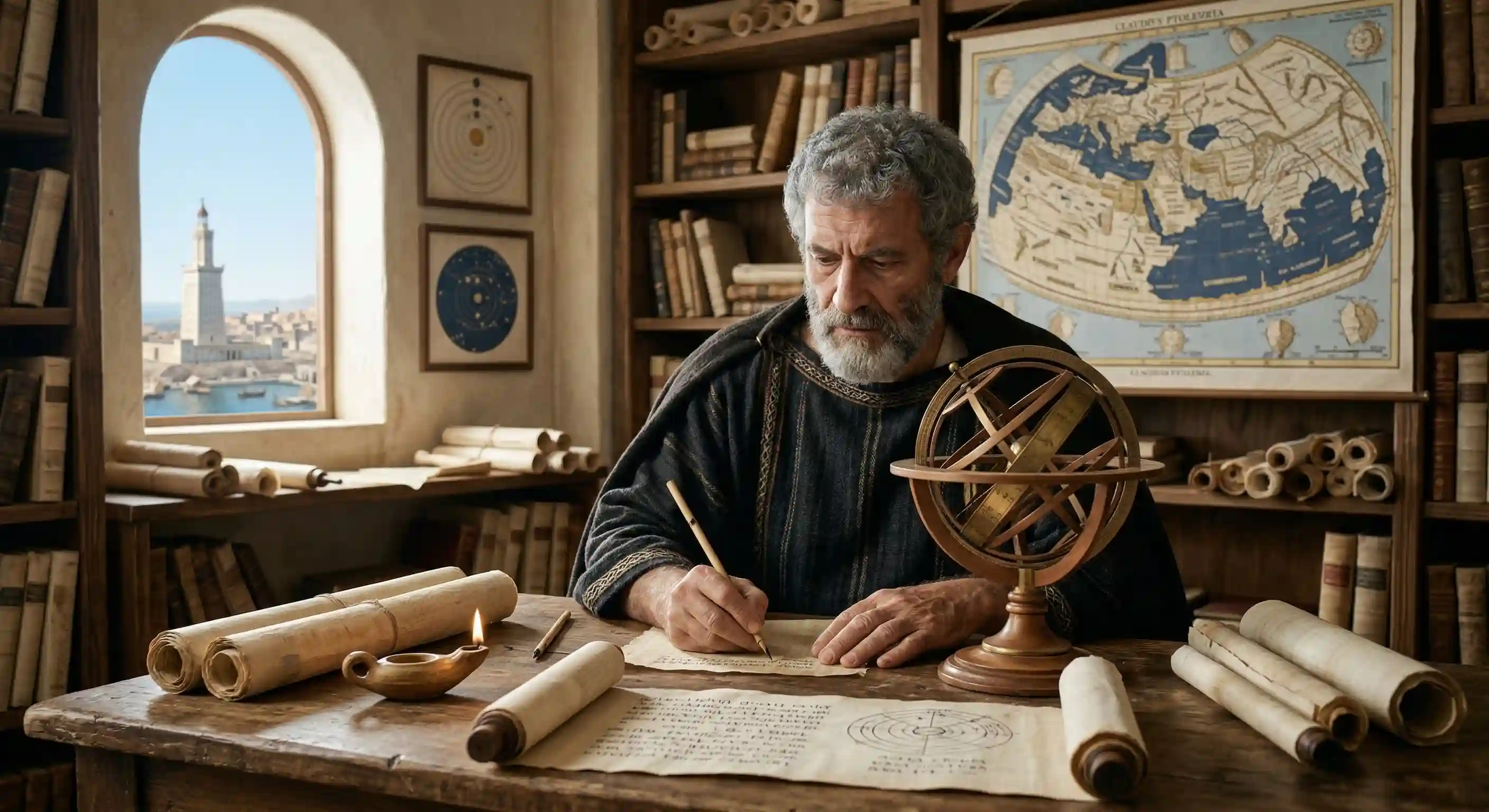
🏛️ The Tetrabiblos — Classical Astrology
9 cycles · 22 initiatory lessons
The Philosophy of Stars and Free Will
🎯 Understand that astrology is not fatality but a tool of prevention.
Ptolemy resolves this with rare philosophical elegance. Astronomical science, he says, operates on two distinct levels. The first is knowledge of the movements of celestial bodies themselves — their position, speed, and mutual configurations. This science is certain, demonstrable, and brooks no serious contest among educated men.
The second level is the prediction of what these configurations produce in the sublunary world: men, animals, plants, and weather. This second art is more uncertain, but no less real. Ptolemy insists: the difficulty of the method does not undermine the reality of the link between the stars and earthly nature.
On free will, Ptolemy takes a nuanced and remarkably modern position. The stars do not compel — they incline. A man forewarned of his natural disposition can, through reason and effort, correct what nature intended for him. The forewarned philosopher is not a slave to the stars. This is the deep purpose of this science: not fatalism, but self-knowledge as a lever of freedom.
⚡ Key Points
- 🌟 Astrology is "medical mathematics" — no absolute fatality
- 💊 The forewarned can apply remedies to celestial influences
- 👶 Birth takes precedence over conception for predictions
- 🧠 A sagacious mind modifies the effect of the stars
🧩 Quiz rapide
According to Ptolemy, can celestial influences be counteracted?
The Nature of Planets and Time
🎯 Master planet classification and the cosmic rhythm.
The Sun is hot and moderately dry. Its heat is obvious — it animates life, ripens fruits, and dries up swamps. Its dryness is more subtle: it absorbs moisture without being destructive. The Moon is cold and moist, like the night and the tides. It governs liquids, moist diseases, and bodily fluids. Saturn is cold and dry — planet of contraction, old age, and penetrating cold. Jupiter is hot and moist — temperate, benefic, favorable to growth. Mars is burning and dry — planet of violent desiccation, fevers, and war. Venus is cold and moist, but in a mild and pleasant way, linked to fertility and pleasure. Mercury is mixed: neither hot nor cold by its own nature, it adapts to the planet it accompanies.
These qualities are not arbitrary: they derive from the position of each planet relative to the Sun and their observable effect on earthly nature. It is physics that founds astrology, not tradition or myth.
⚡ Key Points
- 🌡️ Hot+Moist = Benefic | Cold+Dry = Malefic
- ☀️ Diurnal = masculine | 🌙 Nocturnal = feminine
- ♈ Entry into Aries = Cosmic New Year
- ☿ Mercury & ☀️ Sun = neutral/common
🧩 Quiz rapide
Which planet does Ptolemy describe as 'cold and moist'?
What is the nature of Mercury according to Ptolemy?
Physical Appearance and Constitution
🎯 Deduce physical constitution from the ascendant and planets.
The Ascendant and its ruler are the primary indicators of general morphology. An Ascendant in a fire sign gives a rather dry, nervous, active body. An Ascendant in a water sign produces a fleshier, more fluid body, subject to humoral variations. Saturn ascending or in strong aspect to the Ascendant gives a cold, dry constitution, an elongated face, a pale or olive complexion, and a heavy, deep gaze. Jupiter in a dominant position grants a fine stature, a balanced constitution, and a noble, temperate appearance. Mars undermines grace and gives vivid features, a red or copper complexion, and a robust body often marked by hardship. Venus confers regular beauty and harmonious, pleasing forms. Mercury produces slender, agile types with an alert physiognomy.
The Sun and Moon also play their role: the Moon's position at birth — especially if waxing — enhances bodily moisture and vitality. Ptolemy warns, however: these indications are general. The combination of several planets modifies each factor, and it is the overall judgment that makes the true prognosis.
⚡ Key Points
- ♄ Saturn = cold, dark
- ♃ Jupiter = bright, tall
- ♂ Mars = ruddy, strong
- ♀ Venus = soft, graceful
- ☿ Mercury = proportioned
- 🔄 Animodar = birth time rectification
🧩 Quiz rapide
Which factor in the natal chart is the primary indicator of general morphology?
According to Ptolemy, Saturn in the Ascendant typically gives...
The Mind, Genius and Madness
🎯 Analyse intellectual qualities and mental disorders.
The Sun in a strong position favors nobility of character, clear-sightedness, and magnanimity. A well-placed Moon gives mental flexibility, fertile imagination, and sociability. Saturn, depending on its dignity, can give depth, concentration, and perseverance — or, badly configured, melancholy, pathological slowness, and in extreme cases isolation and cold dementia. Mars in bad condition produces violence, rashness, uncontrollable irascibility, and sometimes fury. Mercury, the planet of intellect par excellence, in a degraded position engenders compulsive lying, cunning, mental instability, and sometimes babbling dementia.
Ptolemy notes that an unfavorable conjunction of Saturn and Mars on the Moon, without a benefic planet to correct it, is a classic sign of serious disorders of the soul. Pathology is not divine punishment: it is a mechanical configuration that the good astrologer can anticipate. This vision sketches, twenty centuries in advance, the idea that temperament and mental disorders have a natural, not supernatural, basis.
⚡ Key Points
- ☿ Mercury = intellect
- 🌙 Moon = emotion/irrational
- ⚠️ Isolated Moon+Mercury + Saturn/Mars = disorders
- ♃ Jupiter = medical healing
- ♀ Venus = divine healing
🧩 Quiz rapide
Which planet does Ptolemy associate with intellect and its disorders?
What classic configuration does Ptolemy signal for serious disorders of the soul?
The Seven Ages of Life
🎯 Understand how each life period is governed by a planet.
The Moon governs infancy (0-4 years): fluid, changeable, unstable. It presides over rapid growth, incessant bodily changes, and total dependence. Mercury takes over until age 14, the age of learning, language, and intellectual formation. Venus rules adolescence (14-22 years), the period of first passions, desire, and awakening to pleasures. The Sun governs youth (22-41 years): the time of ambition, construction, and self-assertion. Mars takes over from 41 to 56 years: the mature man is severe, sometimes bitter, confronted with his limits. Jupiter governs active old age (56-68 years): wisdom, perspective, peace of soul. Saturn finally presides over advanced old age: cold, slowness, withdrawal from the world, the approach of death.
This system is remarkably consistent with the elemental qualities attributed to each planet. It also demonstrates that Ptolemaic astrology is not merely a technique of event prediction, but a true philosophy of human time.
⚡ Key Points
- 🌙 0-4 yrs = Moon (moist, unstable)
- ☿ 4-14 yrs = Mercury (learning)
- ♀ 14-22 yrs = Venus (passion)
- ☀️ 22-41 yrs = Sun (glory)
- ♂ 41-56 yrs = Mars (rigour)
- ♃ 56-68 yrs = Jupiter (wisdom)
- ♄ 68+ yrs = Saturn (withdrawal)
🧩 Quiz rapide
Which planet governs youth (22-41 years) according to Ptolemy?
Which of the 7-age planets governs very early childhood (0-4 years)?
Wealth and the Part of Fortune
🎯 Calculate the Part of Fortune and identify the source of wealth.
The Part of Fortune is calculated from the relationship between the Sun, the Moon, and the Ascendant. It is a symbolic point representing the native's bodily and material "fortune" — their ease or difficulty in accumulating the goods of the world. A well-disposed Part of Fortune, with a good house lord and in favorable aspect with Jupiter, is one of the clearest configurations of prosperity.
Jupiter is the great benefic for wealth: its position and aspects determine the nature of abundance — honors, steady income, inheritances, public offices. Saturn in bad aspect with the Part of Fortune signals wealth hard-earned, delayed, or subject to losses. Mars compromises financial stability through violent expenditures, lawsuits, and accidents.
Ptolemy is careful to distinguish "natural" wealth — that which comes from within the native, from his industry — from "external" wealth coming from inheritances, marriages, and offices. Each has its own indicators in the chart. A competent astrologer must read both separately before formulating an overall judgment.
⚡ Key Points
- 📐 Part Fortune = ☀️🌙 distance from Ascendant
- ♄ Saturn = earthly wealth
- ♃ Jupiter = social wealth
- ♂ Mars = military wealth
- ♀ Venus = relational wealth
- ☿ Mercury = intellectual wealth
🧩 Quiz rapide
How does Ptolemy calculate the Part of Fortune?
Which planet is the 'great benefic' for wealth in Ptolemy?
Social Rank and Vocation
🎯 Read social dignity and determine career from the natal chart.
The Sun is the primary indicator of rank: its angular or cadent position, its essential dignity, its aspects with the superior planets define whether the native is made for public power, magistracy, the arts, or obscurity. A Sun in House X in favorable aspect with Jupiter or Saturn is a configuration of notoriety and social elevation.
The Tenth House (the Midheaven, or MC) is the sector par excellence of vocation: the planet that governs it and the one that "looks at" it most strongly give the nature of the profession. Saturn at the MC favors professions linked to the earth, agriculture, administration, and the elderly. Jupiter presides over liberal professions, justice, and ecclesiastical offices. Mars commands soldiers, surgeons, and blacksmiths. The Sun governs princes and courtiers. Venus governs artists, perfumers, and companions. Mercury governs men of letters, merchants, and scribes. The Moon governs fishermen, travelers, and nurses.
This classification is not rigid in Ptolemy — he warns that several planets can combine to give mixed types. What matters is identifying the dominant planet and interpreting its nature.
⚡ Key Points
- 👑 2 angular luminaries + doryphory = king
- 🏛️ 1 angular luminary = leader
- 🏡 Luminaries out of angles = notable
- 🎯 MC = career planet
- ♀♃☿ = creative/intellectual professions
- ♂♄ = physical/earthly professions
🧩 Quiz rapide
Which house is 'par excellence' the house of vocation according to Ptolemy?
According to Ptolemy, Jupiter at the Midheaven indicates a vocation related to...
Parents, Brothers and Sisters
🎯 Evaluate the condition and longevity of family members.
For parents, Ptolemy identifies the indicators according to sex: the Sun represents the father in the birth chart of a man or woman; the Moon represents the mother. The position of the Sun — its strength, its aspects, the dignity of its dispositor — determines the life conditions of the father, his health, his rank, his death. The Moon, likewise, outlines the mother's fate. Saturn in bad aspect with the Sun can signify a distant, severe father or one who dies early. Mars in square to the Moon can indicate a suffering mother or an early separation.
For siblings, it is the Third House that is investigated, with its ruler and the planets that occupy or aspect it. A strong, well-populated Third House signals several siblings in good health. Jupiter ruler of the III or in favorable aspect with it grants prosperous and benevolent siblings. Saturn or Mars badly placed there announce quarrels, rivalries, or early deaths among brothers and sisters.
Ptolemy is careful to note that the most reliable indications come from the agreement of several factors, not just one. One must cross-reference the state of the Sun, the ruler of the IX, and Saturn for the parents; the ruler of the III, Mercury, and the Moon for siblings.
⚡ Key Points
- ☀️♄ = Father | 🌙♀ = Mother
- ♃♀ harmonious = parental longevity
- ♂ hostile = parental danger
- MC succedent = siblings
- ♂☀️♄ → brothers | ♀🌙 → sisters
🧩 Quiz rapide
Which planet represents the father in the natal chart according to Ptolemy?
Which house does Ptolemy primarily examine for siblings?
Marriage, Love and Children
🎯 Analyse unions, friendships and descendants.
For marriage, Ptolemy primarily consults the Seventh House and its ruler. This house represents the partner, in character as well as social standing. A strong Seventh House, with a good ruler and benefic planets, promises a harmonious and lasting marriage. Venus plays a central role for male natives: its dignity, position, and aspects describe the nature of the woman married. For women, the Moon indicates the male partner. Saturn or Mars ruling the VII announce late, stormy, or painful unions.
Love before marriage — what Ptolemy discusses prudently as "the affections" — is analyzed via Venus and the Moon for men, via the Sun and Mars for women. A good aspect of Venus with the Moon favors harmonious relationships. Their opposition or square suggests disordered or unhappy passions.
For children, the Fifth House is the primary indicator. Jupiter in V or in good aspect with its ruler promises numerous and happy offspring. Saturn in V or in bad aspect suggests few children, difficulty conceiving, or suffering progeny. The Moon also plays a role in fertility, notably through its phase and position in fertile signs (Cancer, Scorpio, Pisces).
⚡ Key Points
- 🌙 = men's marriage | ☀️ = women's marriage
- Mutual trine/sextile = lasting friendship
- ♀♃🌙 at MC = many children
- ♄☀️♂ at MC = few children
- ♊♓♋♏ = twins possible
🧩 Quiz rapide
Which house represents the marital partner in Ptolemy?
Which principal house does Ptolemy consult for children?
Anomalies and Dangers of Early Childhood
🎯 Identify configurations indicating difficult births or threatened survival.
The first factor is the position of the Moon at birth. A Moon in waning phase, combust (too close to the Sun), or in hard aspect with Saturn and Mars without benefic correction, is the signal of a fragile constitution in the newborn. The Moon is the primary indicator of bodily vitality — if it is weakened at birth, so is the body.
The Ascendant plays the second role: if a malefic planet (Saturn, Mars) is in the Ascendant or in square to the Ascendant without reception or benefic aspect, life itself is threatened in its early years. Ptolemy gives very precise rules here: if both luminaries (Sun and Moon) are both in poor position and without aspect from a benefic planet, the child's survival was called into question.
Bodily anomalies — missing limbs, deformities — often correspond, according to Ptolemy, to a strong affliction of Mars (mutilations, violence) or Saturn (cold malformations, atrophies) on the bodily houses (I, VI). Mercury and the Moon afflicted in mutable signs can indicate nervous or mental disorders from youth.
This reading, however grave, responds to an ethical requirement in Ptolemy: the astrologer who can anticipate these risks allows for greater attention from the physician and the family.
⚡ Key Points
- ⚠️ Cadent luminaries + malefics at angles = difficult birth
- 💀 Malefics attacking luminaries alone = infant mortality
- 🙏 Benefics after malefics = abandonment then adoption
- 🐾 Bestial signs = possible deformities
🧩 Quiz rapide
What is the primary factor of fragility in the newborn's constitution according to Ptolemy?
According to Ptolemy, to which planet are bodily malformations and atrophies associated?
Prorogatory Places and Longevity
🎯 Calculate lifespan from the 5 prorogatory places.
The central instrument is the concept of the Apheta — the prorogator or "life-giver": the point in the chart from which the prognosis of life expectancy is measured. The Apheta can be the Sun, the Moon, the Ascendant, the Part of Fortune, or the prenatal conjunction (syzygy), according to precise rules of priority that Ptolemy details.
Once the Apheta is identified, one calculates its direction toward the Anaeretas — the "destroyers of life": Saturn and Mars in the first rank, but also certain critical points of the zodiac (the degrees from tradition). The encounter by direction of the Apheta with an Anaeretes signifies, according to the quality and square of the director, a violent death (Mars), a slow and languishing death (Saturn), or a death by drowning or fever (afflicted Moon).
Jupiter and Venus, conversely, play the role of protectors: when the Apheta meets these benefic planets by direction, one can expect crises overcome, diseases healed, or simply a prolongation of life. This system, despite its apparent complexity, is one of the most coherent developed in Antiquity on the question of length of life.
⚡ Key Points
- 🏆 MC = prorogatory place #1
- 📊 Order: MC > ASC > 11th > DESC > 9th
- 🚫 Subterranean signs = incompetent
- ⭐ Ruling planet of the place = lifespan
🧩 Quiz rapide
What is the technical name for the 'life-giver' in Ptolemy's longevity system?
What type of death does Ptolemy associate with Mars when it is the Anaeretes?
Travels and the Type of Death
🎯 Read travels and the circumstances of end of life.
For journeys, it is primarily the Ninth House that is consulted, with its ruler and the planets that aspect it. A strong IX, with Jupiter or the Sun well-placed, promises distant journeys crowned with success and enrichment. Saturn in IX can indicate arduous journeys, late in life, or stays in cold and desolate regions. A very active Moon in the chart, especially in water or mutable signs, signals a native who is a traveler by nature. The Third House indicates short journeys and regular displacements.
For the nature of death, Ptolemy analyzes the Eighth House, its ruler, and the planets in aspect with the Moon (or Sun, depending on sex). Mars in VIII promises a swift, violent death — through war, accident, or a sharp instrument. Saturn in VIII gives a cold, slow death through chronic illness or extreme old age. Jupiter in VIII ensures a gentle death, surrounded by loved ones. Venus in VIII can indicate a death linked to sensual excesses. The Moon in VIII and combust can signify deaths by water.
Ptolemy insists that this prognosis should never be communicated directly to the client — its value is diagnostic and medical, not sentential.
⚡ Key Points
- 🌙♂ cadent = travels
- ♓♋🦂 = maritime danger
- ♄ = cold/slow death
- ♂ = violent/fast death
- ♃♀ present = peaceful death
🧩 Quiz rapide
Which house does Ptolemy primarily consult for distant journeys?
According to Ptolemy, Jupiter in the Eighth House promises...
Individual vs World — General vs Particular
🎯 Understand the hierarchy between world events and individual destiny.
General astrology deals with phenomena affecting entire collectivities: nations, peoples, cities, seasons, years. Its instruments are the great planetary configurations — conjunctions of Saturn and Jupiter, solar and lunar eclipses, the Sun's entry into cardinal points (equinoxes, solstices). These celestial events outline the great historical tendencies: wars, famines, epidemics, collective prosperities, transformations of kingdoms.
Particular astrology, in contrast, deals with the singular individual in their unique birth. Its primary technique is the analysis of the natal chart: the precise position of all celestial bodies at the hour of birth, their houses, dignities, and aspects. This branch requires an instrumental and chronometric precision that mundane astrology does not demand.
Ptolemy establishes a hierarchy: general astrology has priority over particular astrology. What a great conjunction or eclipse decrees for an entire nation cannot be contradicted by an individual natal chart. The individual is carried by their era as a boat by its currents. But within the limits that the general sets, the particular modulates and nuances each person's personal destiny. This vision is remarkably systemic and prefigures a modern conception of the individual in society.
⚡ Key Points
- 🌍 World > Individual always
- 🌑 Eclipse = major collective event
- ♈♌♐ = Europe (Jupiter/Mars)
- ♉♍♑ = South Asia (Venus/Saturn)
- ♊♎♒ = Persia (Saturn/Jupiter)
- ♋♏♓ = Africa (Mars/Venus)
🧩 Quiz rapide
Which branch of astrology has priority over the other according to Ptolemy?
What are the principal instruments of general astrology in Ptolemy?
Eclipses, Comets and Astro-meteorology
🎯 Interpret eclipses, comets and atmospheric phenomena.
A solar eclipse has public and masculine effects: it affects rulers, cities, and institutions. A lunar eclipse has effects on the general populace, women, harvests, and waters. The duration of the eclipse (measured in hours) determines, according to Ptolemy, the number of years during which its effects will be felt. The sign in which it occurs indicates the type of population or region affected.
Comets are treated differently: they are not simply ill-omened by tradition, but analyzed according to their appearance, trajectory, and the signs traversed. A comet in a fire sign can announce wars and fires; in an air sign, political upheavals; in a water sign, floods and epidemics; in an earth sign, earthquakes and famines.
Astrometeorology — the forecasting of atmospheric weather — is also addressed in this cycle. Seasons are read from the heliacal risings of fixed stars, lunar phases, and the Sun's entry into cardinal signs. Ptolemy carefully enumerates the configurations that announce winds, rains, frosts, and droughts — testifying to a highly developed agricultural astronomical practice in Antiquity.
⚡ Key Points
- 🌑 1h solar eclipse = 1 year of effects
- 🌕 1h lunar eclipse = 1 month of effects
- ☄️ Comet = Mars+Mercury = war/drought
- 🌙 Clear halo = fair | red = wind | black = storm
- ⚕️ Never operate under the Moon's daily sign
🧩 Quiz rapide
According to Ptolemy, how is the duration of the effects of a solar eclipse measured?
A comet passing through a fire sign presages according to Ptolemy...
The Secret of the Hour — The Animodar and Part of Fortune
🎯 Master the fundamental calculations of incarnation.
The basic problem is chronometric: in Ptolemy's era, the exact time of birth was difficult to establish with precision. The Animodar allows correction of the approximate time by seeking the correspondence between the position of the Moon at the syzygy and the position of the Ascendant or a planet in the chart. This technical refinement shows that Ptolemy is not satisfied with approximation: he seeks maximum rigor possible with the instruments of his era.
The Part of Fortune, for its part, is a calculated point — not a planet — obtained by the formula: Ascendant + Moon - Sun (for diurnal nativity) or its inverse (for nocturnal nativity). This point synthesizes the fundamental triad Sun-Moon-Ascendant, the three pillars of the natal chart. It represents what the body can achieve in the material world — embodied fortune.
A Part of Fortune well-aspected by Jupiter or Venus, in a strong sign, is one of the best indicators of prosperity, lasting health, and concrete achievement. It differs from intellectual fortune (Mercury) or spiritual fortune (Ninth House): it is the fortune of the body in its earthly dimension.
⚡ Key Points
- 🔄 Animodar = preceding lunation → exact ASC degree
- 🌓 Part of Fortune = ☀️→🌙 + ASC
- 🌓 = 'Lunar Ascendant' of the natal chart
- 📐 Invariable calculation regardless of hemisphere
🧩 Quiz rapide
What is the purpose of the Animodar technique in Ptolemy?
What does the Part of Fortune represent in the Ptolemaic system?
Masters of Life — Prorogator and Anaeretic
🎯 Determine longevity and the critical turning points of existence.
The Chronocrator system divides life into periods governed successively by the planets. Ptolemy distinguishes several levels: the great planetary periods (years of life governed by each planet according to its own numerical value), and the sub-periods that subdivide each great period. This system allows one to "date" probable events by correlating the active planets with the static indications of the natal chart.
The practical procedure begins by identifying the Chronocrators of the current year for the native, then verifying how these planets behave in the natal chart. If the year is governed by Saturn and Saturn is the ruler of a difficult house in the natal, the year will be trying. If Jupiter governs and it is strong and well-placed, the year will be favorable.
This system coexists with the technique of primary directions — which calculates the evolution of the Apheta over time — and with the annual solar revolutions. Together, these three tools form a coherent and sophisticated system of temporal forecasting, well ahead of what most contemporary astrological traditions proposed.
⚡ Key Points
- 📐 1 equatorial degree = 1 year of life
- ☠️ Anaeretic = planet/aspect that 'cuts' life
- ♄♂ = most common anaeretics
- 🏆 MC = most powerful prorogator
- ⚠️ Subterranean signs = invalid as prorogators
🧩 Quiz rapide
What are the Chronocrators in the Ptolemaic system?
If the year is governed by Saturn and Saturn rules a difficult house in the natal chart, what can be expected?
Material Wealth vs Glory and Honours
🎯 Differentiate money from power in the natal chart.
Material wealth is read through the Second House, the Part of Fortune, and the benefic planets in aspect with them. A chart can show considerable economic resources (Jupiter in II, strong Part of Fortune) without indicating a high social rank or public glory. This is the case of the obscure rich man — the flourishing businessman unknown to the general public.
Glory and honors, in contrast, are read in the Tenth House, the Midheaven, and the position of the Sun. An angular Sun, in aspect with Jupiter and Saturn from positions of strength, promises notoriety, public offices, and honors bestowed by institutions. This glory can exist without corresponding wealth — this is the case of the upright but poor magistrate, the famous philosopher without possessions.
Ptolemy also notes a third form of "wealth": wealth in friendships, support, and social connections. It is read in the Eleventh House (friends, benefactors). A native with few planets in II but many in XI may prosper through networks rather than direct income. This subtle distinction between forms of social capital is remarkably prescient.
⚡ Key Points
- 💰 Part Fortune = material wealth
- 👑 Luminary doryphory = glory and rank
- ♃ well-placed = inheritance, government
- ♀ well-placed = arts, gifts, beauty
- ♂ escort = military power
- ☿ escort = intellectual authority
🧩 Quiz rapide
According to Ptolemy, House XI represents what form of wealth?
For glory and public honors, Ptolemy primarily reads...
The Star of Vocation and Trades
🎯 Find the native's professional path.
The method always begins by identifying the planet or planets that govern the MC — either by direct occupation or by rulership of the MC's sign. This "vocation planet" outlines the general nature of the profession. But Ptolemy goes further: he crosses this indication with the nature of the Ascendant and the planets that govern it. A Mercurial MC in a chart with a Jovian Ascendant will give a prosperous and influential man of letters. The same Mercurial MC with a Saturnian Ascendant will give an austere and solitary scholar.
Ptolemy also introduces the notion of "mixed professions" — vocations that combine several planetary natures. A physician, for example, combines Mars (surgery, cuts), Saturn (chronic illnesses, old age), and the Moon (fluids, bodily humors). A musician combines Venus (harmony, pleasure) and Mercury (technique, digital precision). These combinations explain the infinite diversity of human professions.
He insists finally that vocation does not determine rank: an exceptional carpenter with strong Mars and Sun may be more remarkable in his art than a dilettante nobleman, even if the latter occupies a higher social position.
⚡ Key Points
- 🎯 Oriental planet near ☀️ = main vocation
- 🎯 Planet at MC = public vocation
- ☿ = pen and word
- ♀ = beauty and aromas
- ♂ = iron and fire
- ♀+☿ = performing arts
🧩 Quiz rapide
What does Ptolemy do to obtain a nuanced vocational portrait?
What example does Ptolemy give of a 'mixed profession' combining several planetary natures?
The Mysteries of Union and Marriage
🎯 Predict unions, the spouse's nature and fidelity.
The first criterion is the relationship between Venus and Mars in the natal chart. If these two planets are in good mutual aspect (trine, sextile), the union will be harmonious on the passionate level. If they are in square or opposition, conflicts between desire and will, between love and power, will traverse the marriage. Saturn in aspect with Venus cools relationships and can indicate a marriage of convenience, late in life, or with a much older partner.
The question of multiple marriages — a delicate subject but addressed honestly by Ptolemy — is linked to the position of the ruler of the VII in a double sign (Gemini, Virgo, Sagittarius, Pisces) or to the presence of several planets in VII. These configurations do not necessarily imply infidelity — they can indicate widowhood followed by remarriage, or simply two important and successive relationships.
For women, Ptolemy reads the conditions of marriage primarily through the Sun and Saturn, in addition to the VII: the Sun indicates the husband, Saturn indicates the constraints of marriage (mourning, separation, distance). A cross-study of these three factors allows an overall and nuanced judgment on the native's marital destiny.
⚡ Key Points
- 🌙 eastern = early marriage (men)
- ☀️ eastern = early marriage (women)
- ♀ configured = beautiful joyful spouse
- ♄ configured = austere spouse
- ♂ configured = quarrelsome spouse
- △ ✶ mutual luminaries = solid marriage
🧩 Quiz rapide
What relationship between Venus and Mars indicates a harmonious marriage according to Ptolemy?
What configuration can indicate several successive marriages according to Ptolemy?
Signs of Adventure and Travel
🎯 Identify nomads and travellers in a natal chart.
Short and habitual journeys are governed by the Third House, Mercury, and the Moon in mutable signs. A native with Mercury in III and the Moon in Gemini will be naturally active, communicative, in perpetual motion. These displacements are part of their ordinary way of life — they are neither dangerous nor exceptional.
Long and initiatory journeys fall under the Ninth House, Jupiter, and the Sun. A Sun in IX, especially in an air sign (Gemini, Libra, Aquarius) or fire sign, promises revealing distant voyages. Jupiter in IX guarantees that these journeys will be beneficial, enriching, protected by fortune.
Ptolemy also adds an analysis of "forced journeys" — exiles, flights, imposed uprooting. Mars afflicting the Sun and the IX, with Saturn in bad aspect on the ruler of the Ascendant, can indicate brutal departures from one's native country. These configurations are found in the political exiles and refugees that ancient history knew well.
The sea and maritime voyages are particularly indicated by the Moon in water signs, by Neptune (which Ptolemy did not know but whose effects are absorbed by the Moon and water signs in his system), and by the position of planets in the cadent houses linked to foreigners.
⚡ Key Points
- 🌙♂ cadent = life of travel
- ♊♍♓ bicorporeal = incessant travel
- ♃♀ = lucrative journeys
- ♄ = solitary/long journeys
- ♂+water signs = shipwrecks
- ♂+human signs = brigands
🧩 Quiz rapide
Which zodiacal signs are particularly linked to maritime journeys in Ptolemy?
What configuration indicates a 'forced journey' or exile according to Ptolemy?
The Anatomy of Eclipses and Comets
🎯 Master world astrology and the prediction of catastrophes.
The first question is geographical: does the eclipse affect all regions of the world equally? No, answers Ptolemy. The impact is particularly strong in regions situated under the eclipsed sign and in countries for which this sign is the traditional "rising" or "indicating" sign. An eclipse in Aries particularly affects Persia and eastern Syria; an eclipse in Taurus, Italy and Babylonia, etc. Ptolemy establishes a geo-zodiacal correspondence that structures his entire system of geopolitical forecasting.
The second question is temporal: when will the effects be felt and how long will they last? The duration of the eclipse in hours (for a solar eclipse) or in hours converted to months (for a lunar eclipse) gives the temporal extent of its influence. A two-hour total solar eclipse will have effects lasting two years.
The third question is qualitative: what type of event? The nature of the planet that "governs" the eclipse (the ruler of the eclipsed sign, the closest planet) determines the type of calamity or benefit. Saturn announces famine, cold, and the death of the elderly. Mars announces wars and fires. Jupiter, despite its good nature, can in this ecliptic context signify disturbances of religious or civil institutions.
⚡ Key Points
- ⬛ Black eclipse = Saturn (famine/cold)
- ⬜ White eclipse = Jupiter (prosperity)
- 🔴 Red eclipse = Mars (war)
- ☄️ Comet tail = threatened direction
- ⏱️ 1h solar = 1 year | 1h lunar = 1 month
🧩 Quiz rapide
According to Ptolemy, how does an eclipse differently affect regions of the world?
An eclipse whose 'governing' planet is Mars announces according to Ptolemy...
The Wisdom of the Centiloquy — The 100 Golden Rules
🎯 Apply Ptolemy's 100 ethical and practical aphorisms.
The Centiloquium is a collection of a hundred brief sentences, each condensing an astrological rule or practical wisdom. Some are purely technical ("When the Moon is at a distance of 15 degrees from a planet, it begins to receive its virtue"). Others are philosophical and ethical ("Be prudent in your judgments, for the stars incline without compelling"). Still others are strikingly concise on themes such as health, journeys, and relationships.
The most famous aphorism — and the one that summarizes all of Ptolemy's philosophy — is the first: "He who knows the secrets of the stars can prevent many evils." This is not a promise of infallible divination, but an invitation to preventive wisdom. The astrologer is not a prophet — he is a physician of time.
The Centiloquium also represents the pedagogical transcription of a living school: these aphorisms were learned by heart by students, debated, and commented upon. They still form today the basis of traditional astrological teaching in many schools that claim the Ptolemaic tradition. The cycle ends here, but the practice begins.
⚡ Key Points
- 📖 Aph. V = free will preserved
- 📖 Aph. VIII = the wise improves their destiny
- 📖 Aph. X = caution with malefics
- 📖 Aph. XX = surgery and lunar sign
- 🎓 100 aphorisms = astrologer's ethics
🧩 Quiz rapide
What is the first and most famous aphorism of the Ptolemaic Centiloquium?
According to Ptolemy, the role of the astrologer is comparable to that of...
Want unlimited Tina AI on all courses?
🔮 See our plans →