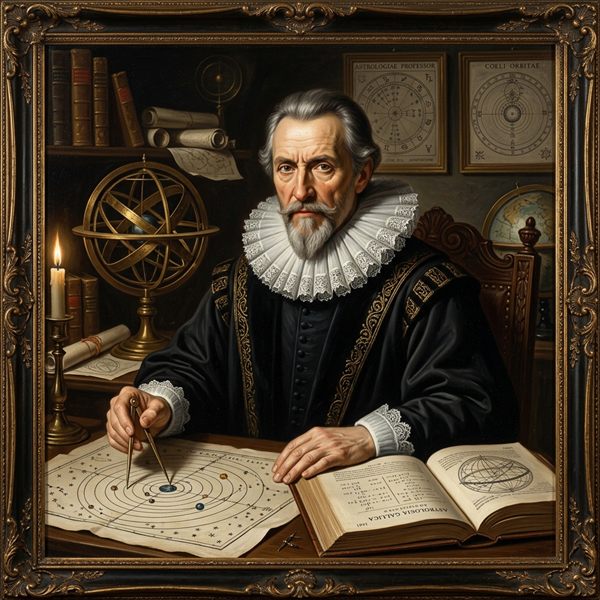
⚜️ Astrologia Gallica — Rational Astrology
The magisterial work of the greatest French 17th-century astrologer
Jean-Baptiste Morin de Villefranche (1583–1656), royal mathematician, physician and court astrologer, devoted 40 years to writing the Astrologia Gallica — a monumental 26-book work aiming to place astrology on rational and theological foundations. His system of 'casual determinisms' and method of reading Houses remain an indispensable reference.
🏛️ Rational and Theological Foundations
The Clash of Titans — Ptolemy vs Morin de Villefranche
🎯 Understand why Morin revolutionises the Ptolemaic method and how to marry both systems for complete astrology.
You have assimilated the majestic architecture of Claudius Ptolemy. Now let us leap to the 17th century to meet the "Descartes of astrology": Jean-Baptiste Morin de Villefranche.
1. THE TRAP OF UNIVERSAL SIGNIFICATORS
Ptolemy worked through universal analogies: the Sun and Saturn always signify the father, the Moon and Venus always the mother. Morin revolts against this method.
If the Sun were the universal significator of the father, all children born when the Sun is well-aspected would have a rich, happy father — absurd! Planets are universal causes with no preference for Peter over Paul. To signify a specific individual's father, a planet must be locally determined: it must occupy the 4th House (that of parents) or be its ruler.
2. THE GREAT REVOLUTION: CELESTIAL STATE VS TERRESTRIAL STATE
🌌 Celestial State (The "How"): planet's nature + zodiac sign + aspects received. Common to the whole Earth at a given instant. Decides exclusively the QUALITY of effects (good or bad, happy or difficult).
🏠 Terrestrial State (The "What"): planet's position in the subject's Houses. Unique to the individual. Decides the CATEGORY of events.
Example: Venus in excellent celestial state (in Taurus, trine Jupiter) = great happiness... but where? In House II → great financial wealth. In House XII → protection against illness or hidden enemies. The celestial state gives quality; the terrestrial state gives the life domain.
3. THE IRON LAW: PRESENCE vs DOMINATION
The physical presence of a planet in a House is always more powerful than its mere domination.
Example: Saturn, ruler of Capricorn on the cusp of House XII (illness). If Saturn is physically in House X (career), it impacts career infinitely more than illness. Morin's golden rule: "The presence of a planet outweighs the domination of an absent planet."
4. SYNTHESIS: MARRY THE TWO GIANTS
• Ptolemy = the Thesis: archetypal, poetic, symbolic value. Philosophical depth.
• Morin = the Cartesian Antithesis: mathematical discipline, individualisation, grounding in lived reality.
An astrologer without Ptolemy lacks depth. One without Morin remains trapped in confused ancient aphorisms. The accomplished astrologer embodies their synthesis: the universality of one, allied to the precision of the other.
⚡ Key Points
- 🚫 Ptolemaic trap: universal significators = error for individual charts
- 🌌 Celestial State = quality of outcome (good/bad) — common to the whole Earth
- 🏠 Terrestrial State = life domain (which house) — unique to the individual
- ⚖️ Iron Law: physical presence > sign domination
- 🏆 Ptolemy (universality) + Morin (precision) = accomplished astrologer
🧩 Mastery Quiz
According to Morin, what determines the QUALITY (good or bad) of a planetary effect?
Saturn, ruler of Capricorn in House XII (illness), is physically in House X (career). What does Morin predict?
Why does Morin reject universal significators (e.g. Sun = father for everyone)?
Examination Session — The Professor's 5 Questions
🎯 Test and consolidate understanding of the Ptolemy / Morin dialectic through a rigorous academic examination.
───────────────────────────────────────
Q1 — The Critique of Universal Significators
What is Morin's fundamental critique of Ptolemy's universal significators?
Answer: The error of the Ancients was believing a planet could, through its mere natural analogy, signify a specific event for an individual. If the Sun universally signified the father, all children born under a well-aspected Sun would have a happy father — absurd. Celestial causes are universal and indifferent to individuals. To signify a specific subject's father, the planet must undergo local determination: physically occupying the 4th House or being its ruler.
───────────────────────────────────────
Q2 — Celestial State and Terrestrial State
How does Morin structure interpretation through these two concepts?
Answer: The Celestial State (nature + sign + aspects) is common to the whole Earth at a given moment: it decides exclusively the quality (good or bad) of effects. The Terrestrial State (position or domination in the 12 Houses) is particular to the individual: it decides the category of events. The magisterial rule: the celestial combination decides quality; the terrestrial state indicates in which life domain (the category) the effect will strike.
───────────────────────────────────────
Q3 — Morin's Iron Law
What is this law and how does it supersede Ptolemaic domination?
Answer: "The presence of a planet in a House outweighs the domination of an absent planet." Corporal determination is immediate and therefore the most effective. Example: if Capricorn is on the 12th House cusp (illness) and Saturn, its ruler, is in the 10th House (career), Saturn acts with infinitely more force on profession than on illness. It operates directly where it is present, and only through the sign where it dominates.
───────────────────────────────────────
Q4 — The Alchemy of Destinies: The Richelieu Case
How does the alchemy of destinies operate when a House ruler physically occupies another House?
Answer: When a planet ruling one House is found in another, it presages an inevitable combination of those two Houses' meanings. The governed House is the cause; the occupied House is the effect. If the ruler of House XII (occult enemies, captivity) is in House X (power, honours), the subject's enemies and misfortunes will form the starting point of their dignities. Morin cites Cardinal Richelieu: his enemies only served to propel him toward absolute glory — a perfect illustration of this configuration.
───────────────────────────────────────
Q5 — Ptolemy's Rigour on Mental Illness
How does Ptolemy explain the origin of madness and epilepsy?
Answer: Do not scorn Antiquity — Ptolemy was an exceptional observer. He sets two strict conditions: (1) the Moon (sensitive soul) and Mercury (rational soul) must have no connection between themselves or with the Ascendant; (2) the malefic planets (Saturn and Mars) must predominantly control the chart's angles. Ptolemy refines: if malefics govern alone → the illness is incurable but not outwardly visible. If benefics (Jupiter, Venus) are oriental and angular → the illness is spectacular but curable: Jupiter brings medical healing, Venus divine intervention.
───────────────────────────────────────
Ptolemy offers you the poetry of archetypes and the reading of Nature's great universal causes; Morin provides the mathematical and logical tool to anchor these forces in the intimate theatre of the individual.
⚡ Key Points
- 🔑 Local determination = the only way a planet can signify a precise individual event
- ⚖️ Celestial State (quality) × Terrestrial State (category) = Morin's complete equation
- 🏠 Corporal presence > distant domination — Morin's absolute law
- ⚜️ Ruler of XII in House X = misfortunes become the springboard to glory (Richelieu case)
- 🧠 Ptolemaic madness = Moon + Mercury isolated + malefics at angles — but curable if benefics are oriental
🧩 Mastery Quiz
According to Morin, what is the distinction between a planet weakened in a sign (Fall) and a planet in the sign opposite to its domicile (Exile/Detriment)?
Give an example of local determination for marriage according to Morin: which planet, in which House, must be observed as a priority?
How does Ptolemy analyse doryphory to determine whether a native will be a king or a mere notable?
🌟 Celestial Alchemy — Nature, Dignities and Debilities
Essential Nature and the Sign as Garment
🎯 Understand that each planet acts jointly with its sign, and that the quality of this alliance determines the purity of the effect.
Before knowing where a planet will act in your life (Terrestrial State), one must absolutely determine how it fares: this is the Celestial State.
Each planet has its own nature: benefic like Jupiter or Venus, malefic like Saturn or Mars. But the planet never acts alone — it acts jointly with the Zodiac Sign it traverses, which serves as its 'garment'.
This Sign is governed by a Master, and the tenant planet totally depends on the state of this landlord. For example, if Jupiter (planet of wealth) traverses Aries, it acts under the dependence of Mars (Master of Aries). If Mars is poorly positioned in this chart, Jupiter's benevolent action will be tainted, delayed or mixed with violent conflicts.
Imagine an ambassador (Jupiter) sent on a diplomatic mission to a foreign country (Aries). If the king of that country (Mars) is hostile or weakened, the ambassador cannot fully accomplish his mission, whatever his own excellence.
Nature + Sign = quality of action. This is Morin's first equation, the one every astrologer must solve before even looking at the Houses.
THE RULER AS HOST
Imagine the planet as a traveler lodging at an inn. The inn is the Sign. The innkeeper is the Sign's Ruler. If the innkeeper is prosperous and benevolent (a strong, well-aspected planet), the welcome will be excellent and the traveler will flourish. If the innkeeper is in a poor situation, the lodging will be mediocre and the traveler will suffer for it.
ESSENTIAL DIGNITIES: THE HIERARCHY OF STRENGTH
Morin inherits the tradition of Essential Dignities: the degrees of inherent strength of each planet in the Zodiac.
• Domicile: the planet is at home (maximum strength)
• Exaltation: the planet is an honored guest (high strength)
• Detriment: the planet is in the opposite house (weakened)
• Fall: the planet is in the sign opposite its exaltation (minimum strength)
It is the complete Celestial State of a planet that determines whether its effects will be beneficial or harmful in the native's life — not its nature alone.
⚡ Key Points
- 🌟 Each planet acts jointly with its zodiac sign — one does not go without the other
- 🏠 The sign is the 'garment' that colours and modifies the planet's own nature
- 👑 The sign's Master is the host: their state directly affects the tenant planet
- 📐 Celestial State = nature + sign + aspects = quality (good or bad) of the effect
- ⚠️ A benefic planet hosted by an afflicted Master loses part of its benevolence
🧩 Mastery Quiz
Jupiter is in Aries. Mars (Master of Aries) is poorly disposed. What is the consequence for Jupiter?
What does a planet's Celestial State exclusively determine?
Dignities, Debilities and the Feral Planet
🎯 Evaluate the power or corruption of a planet according to its domicile, exaltation, exile, fall, and isolation.
1. IN DOMICILE or EXALTATION — Pure Power
The planet is at home, sovereign. Its action is pure, direct, unmixed. For example, the Sun in Leo expresses its nature in its full splendour. It needs no host: it IS the host.
2. IN EXILE (sign opposite domicile) — Weakening
The planet is in enemy territory. Its capacity to act well is simply weakened, reduced. It cannot fully deploy its qualities.
3. IN FALL (sign of debilitation) — Active Corruption
This is far worse than Exile. Fall actively perverts the planet's nature and directs its effects toward evil. For example, Saturn (prudence, slow elevation) in Aries (its Fall) produces extreme inertia, a base trade, or makes an elevation followed by spectacular downfall and infamy. The planet does not merely fail — it causes damage.
4. THE FERAL PLANET — Stellar Solitude
A planet forming no aspect with other stars is called 'feral' (wild). It is cut off from the planetary network, left to itself. For example, a feral Saturn in House I (personality) presages a hermit's life or a fierce man fleeing society — isolated like the planet itself.
Golden rule: a planet in Domicile or Exaltation strengthens its promises; in Exile it diminishes them; in Fall it perverts them; feral, it isolates them.
⚡ Key Points
- 🏰 Domicile/Exaltation = sovereign planet, pure and powerful action
- 🚪 Exile = simple weakening — the planet struggles to act well
- 💀 Fall = active corruption — the planet acts in a perverse direction
- 🐺 Feral planet = no aspects, isolated action, sign of social isolation
- ⚖️ Fall is always more harmful than Exile according to Morin
🧩 Mastery Quiz
Saturn is in Aries (its Fall). What effect does Morin predict?
What is the fundamental difference between Exile and Fall?
⚔️ The Terrestrial Battlefield — Stellia and Conflicts
Primacy of Presence — Morin's Absolute Principle
🎯 Integrate the fundamental law: a planet's corporal presence in a House always outranks its mere distant domination.
We now place our actors on the stage of your life: the 12 Astrological Houses. This is Local Determination — the 'What'.
THE INVIOLABLE LAW: PRESENCE > DOMINATION
A planet's corporal presence in a House always crushes mere domination.
For example: Capricorn is in House XII (the House of illness). According to old tradition, Saturn (Master of Capricorn) governs these illnesses. But if Saturn itself is physically in House X (career), what happens? Saturn will act with infinitely superior force on the subject's profession (House X, where it is present) than on their illnesses (House XII, where it dominates only through the sign).
Space itself is empty and inactive. A House without a planet acts entirely through its Master. But that Master acts first where it is physically LOCATED.
This is the difference between a general commanding troops from the front line (presence) and a general sending written orders from the capital (domination). The former is infinitely more effective.
Practical consequence: when analysing a chart, ALWAYS look first at where planets are physically located, before worrying about the signs they govern from afar.
⚡ Key Points
- ⚡ Absolute law: corporal presence in a House > domination through sign
- 🏠 An empty House acts through its Master — but that Master acts first where it is
- 🎯 Always look at planets' physical positions as a priority
- 📍 Local determination (occupied House) is the most powerful of all
- ⚔️ General at the front (presence) = infinitely more effective than general at the capital (domination)
🧩 Mastery Quiz
Capricorn is in House XII. Saturn is in House X. On which House does Saturn act most strongly?
Planetary Stellia — Morin's Own Chart
🎯 Understand what the concentration of several planets in the same House signifies, and how benefics and malefics neutralise or amplify each other there.
THE EMBLEMATIC CASE: MORIN'S OWN CHART
Morin de Villefranche had FIVE stars gathered in his own House XII (the House of illness, prisons and occult enemies): Venus, Sun, Jupiter, Saturn, and Moon.
What happened in his life? He tells us himself, with stunning candour:
— He narrowly escaped death ten times
— He endured sixteen episodes of captivity or servitude
— He was persecuted by the formidable Cardinal Richelieu (the quintessential occult enemy)
But observe the subtle mastery: because Jupiter and Venus (BENEFIC planets well disposed) were part of this stellium, Morin ALWAYS miraculously escaped! The benefics acted as guardian angels amid the storms.
INTERPRETATION RULE FOR STELLIA:
• Malefics in majority → severe and potentially destructive trials
• Benefics present in the stellium → attenuation, survival, positive resolution
• Both in balance → dramatic but overcome life
What life domain would be affected if this configuration were in your House II (money), House VII (marriage), or House X (career)? The answer changes radically — but the interpretation rule remains identical.
⚡ Key Points
- 🌐 Planetary stellium (3+ planets in a House) = extraordinary events in that domain
- ⚜️ Morin had 5 planets in House XII → 10 near-deaths, 16 captivities
- 🛡️ Jupiter + Venus in the stellium = miraculous protection despite trials
- ⚖️ Malefics in majority = probable destruction; benefics present = survival
- 🎭 The stellium's House determines the DOMAIN of extraordinary events
🧩 Mastery Quiz
Morin had 5 planets in House XII including Jupiter and Venus. Why did he always survive his trials?
🎯 Celestial Kinematics — Aspects, Application and Separation
Aspects — The Nature of Planetary Rays
🎯 Master the classification of aspects by their benefic or malefic nature, and understand why a good aspect from a poorly disposed planet can be harmful.
Planets are not fixed — they move and project energy rays called 'Aspects'. Through these rays they associate, assist, or destroy each other.
CLASSIFICATION OF ASPECTS
The Trine (120°) and Sextile (60°) are naturally benefic: they allow harmonious cooperation between planets.
The Square (90°) and Opposition (180°) are naturally malefic: they create tension, conflict, and destruction.
But — and this is where most charlatan astrologers go wrong — the nature of the aspect alone is not enough! One must combine the aspect's nature WITH the quality of the planet emitting it.
For example: the Trine (good aspect) of a Jupiter poorly disposed in exile will be of no help to you. Jupiter is weakened; its ray is therefore weakened, even if it arrives at a favourable angle.
Conversely: the Square (bad aspect) of a powerful Saturn in domicile will be far more fatal than a Trine from that same weakened Saturn. The Opposition (very violent aspect) of the Sun to Saturn, when Saturn is in Leo and the Sun in Aquarius — the frame of its own exile — is the worst of all possible aspects: a true solar destruction.
Golden rule: benefic aspect × strong planet = great help; malefic aspect × strong planet = great peril. The quality of the source takes precedence over the nature of the vector.
⚡ Key Points
- ✶ Trine and Sextile = benefic aspects (harmonious cooperation)
- ⚔️ Square and Opposition = malefic aspects (tension and destruction)
- ⚠️ A good aspect from a weak planet is almost worthless
- 💥 A bad aspect from a strong planet = maximum peril
- ☀️ Sun-Saturn Opposition with Saturn in Leo = most destructive aspect
🧩 Mastery Quiz
Jupiter is in exile (weakened) and forms a Trine with your Ascendant ruler. What does Morin predict?
Application and Separation — The Great Secret of Dynamic Astrology
🎯 Understand the crucial difference between a planet approaching an aspect (growing force) and one separating from it (declining force).
APPLICATION — Force Rises
When the faster planet approaches the other to form an aspect, force is growing. The angle tightens like a vice. The effect is of formidable power because it is not yet accomplished.
For example: if the ruler of your Ascendant (symbolically yourself) approaches Mars, ruler of House VIII (death), this is an imminent presage of acute fevers, violent brawls or serious danger of death. The arrow is in flight — it will strike.
SEPARATION — Force Declines
When the faster planet moves away after forming the aspect, the effect gradually extinguishes. The event is either past or resolving.
For example: if that same ruler is separating from Mars, danger diminishes drastically. The event will be only an outline or you will escape it — like an arrow grazing you instead of piercing you.
INCOMPLETE APPLICATION — Retrogradation
Sometimes a planet approaches another, but BEFORE the aspect forms, it turns retrograde (moves backward). This is an incomplete application. Result: the expected event will begin but be abruptly stopped or deeply hindered. The promise will only be half-kept — or never.
Practical rule: when interpreting a chart, always check whether important aspects are forming (application) or dissolving (separation). This is the difference between a real danger and a past one.
⚡ Key Points
- 🎯 Application = aspect forming → growing force, imminent effect
- 💨 Separation = past aspect → declining force, resolved danger
- 🔄 Incomplete application (retrogradation) = event started but hindered
- ⚔️ Ascendant ruler approaching Mars (House VIII ruler) = imminent mortal danger
- 🛡️ Ascendant ruler separating from Mars = past danger, escape achieved
🧩 Mastery Quiz
The ruler of your Ascendant is approaching Mars (ruler of House VIII). What is Morin's prediction?
🔀 The Transfer of Destinies — The Master in Local Exile
The Secret of Empty Houses and the Transfer of Meaning
🎯 Understand how to interpret an empty House and what it means for a House ruler to reside in another House.
THE SECRET OF EMPTY HOUSES
Many apprentice astrologers panic before an empty House. Error! When a House is occupied by no planet, its effects are judged according to the nature and state of its Master. Space is empty and inactive — the House then acts entirely through the planet governing it.
THE TRANSFER OF MEANING
Here is the magisterial principle: when a planet that is master of one House is physically found in another House, the meanings of these two Houses will inevitably combine.
Imagine Houses as medieval castles. If the Lord (the Master) of the Wealth castle (House II) goes to live corporeally in the Illness castle (House XII), the subject's wealth will be 'transferred' and swallowed by illnesses or occult enemies.
THE CAUSE/EFFECT RULE
The House the planet GOVERNS is the cause — the origin of the event.
The House it physically OCCUPIES is the effect — the arrival point, the theatre of realisation.
Example 1: Master of House II (finances) in House VII (marriage, contracts). If benefic → fortune through marriage or won lawsuits. If malefic → financial ruin through the spouse or litigation.
Example 2: Master of House XII (enemies, exile) in House X (honours, power). If benefic and strong → enemies and trials will be precisely the springboard to glory. Exactly what the case of Cardinal Richelieu illustrates in Morin's chart.
⚡ Key Points
- 🏰 Empty House = no panic! Judge by the House's Master
- 🔀 Master of one House in another = inevitable combination of both domains
- ⚡ Governed House = cause/origin; Occupied House = effect/realisation
- 💰 Master II in VII → fortune through marriage (if benefic) or ruin through spouse (if malefic)
- ⚜️ Master XII in X (benefic) → enemies become the springboard to glory
🧩 Mastery Quiz
The ruler of House I (you) is in House VIII (death). The ruler of VIII is in House I. Is the effect identical?
🤝 Planetary Hospitality and the Destiny of Others
Receptions — Simple, Reciprocal and Poisoned
🎯 Understand how planets 'visit each other' via receptions, and why a mutual exchange can be a benefic pact or a deadly poison.
SIMPLE RECEPTION
When a planet traverses a Sign that is not its own, it is 'received' by that Sign's Master, who becomes its host. It then totally depends on that host's disposition.
For example: Jupiter in Aries is received by Mars. If Mars is strong and well disposed in the chart, Jupiter benefits from this hospitality and produces good effects. If Mars is afflicted, the hospitality is poor — Jupiter's effects are tainted.
RECIPROCAL RECEPTION — PACT OR POISON?
Sometimes two planets invite each other mutually: Venus is in Aries (at Mars's home) and Mars is in Taurus (at Venus's home). This is a reciprocal reception — an exchange of domiciles.
But Morin warns us against a terrible disillusion! If these two planets are simultaneously in their places of Exile or Fall, the pact is poisoned.
Classic example: Saturn in Cancer (its exile, at the Moon's home) and the Moon in Capricorn (its exile, at Saturn's home). If these two stars are in opposition, Morin considers this extremely pernicious. The two hosts hate each other and destroy each other from a distance — like two diplomats who exchange ambassadors but simultaneously declare war.
⚡ Key Points
- 🤝 Simple reception = planet at a host's home (sign's Master) — depends on host's state
- 🔄 Reciprocal reception = two planets exchange their signs
- ☠️ Reciprocal reception in Exile or Fall = poisoned pact, mutual destruction
- 🌙 Saturn in Cancer + Moon in Capricorn in opposition = example of maximum poison
- 🏠 The host's quality determines the quality of the welcome — and thus the effect
🧩 Mastery Quiz
Saturn is in Cancer (its exile) and the Moon is in Capricorn (its exile), in opposition. How does Morin judge this reciprocal reception?
The Destiny of Others — The Illusion of the Ancients and Derived Houses
🎯 Understand how to see the destiny of a third person (sibling, spouse, child) in one's own natal chart through derived Houses.
The Ancients — even the great Ptolemy — looked at House VIII (death) in an individual's chart to predict the death of their parents, spouse or children. Morin demonstrates this is heresy!
The essential meanings of a House refer only to the subject themselves. House VIII is YOUR death — not your neighbour's.
THE REVERSAL OF MEANING
So what does the presence of the Master of House III (siblings) in your House VIII mean? It does not predict that your siblings will die! It presages that your siblings could be the direct or indirect cause of YOUR death.
THE SECRET OF DERIVED HOUSES
How then to see my sibling's death in my own chart? Morin reveals a secret as brilliant as clockwork:
Your sibling is represented by House III. Their own House of death (VIII) is counted from theirs: it is the 8th House from the 3rd... therefore your House X.
If the Master of House III (your sibling) is afflicted in your House X → THIS threatens your sibling with death, not you!
The mechanism reads like a clock: each wheel drives the next.
• Father = House IV → his death = House 4+8=12
• Spouse = House VII → their death = House 7+8=14 = House 2
• Child = House V → their death = House 5+8=13 = House 1
⚡ Key Points
- 🚫 ANCIENTS' ERROR: House VIII only predicts YOUR death, not another's
- 🔄 Master III in House VIII = your siblings will be the cause of your death (not the victims)
- ⚙️ Derived Houses: count 8 Houses from the one representing the person
- 👨👩👧 Sibling's death = House X (3+8=10); spouse's death = House II (7+8=14=2)
- 🕰️ The mechanism reads like a clock — each wheel drives the next
🧩 Mastery Quiz
I want to see in MY natal chart whether my sister (House III) is in danger of death. Which House must I analyse?
📚 Related resources
Want unlimited Tina AI on all courses?
🔮 See our plans →