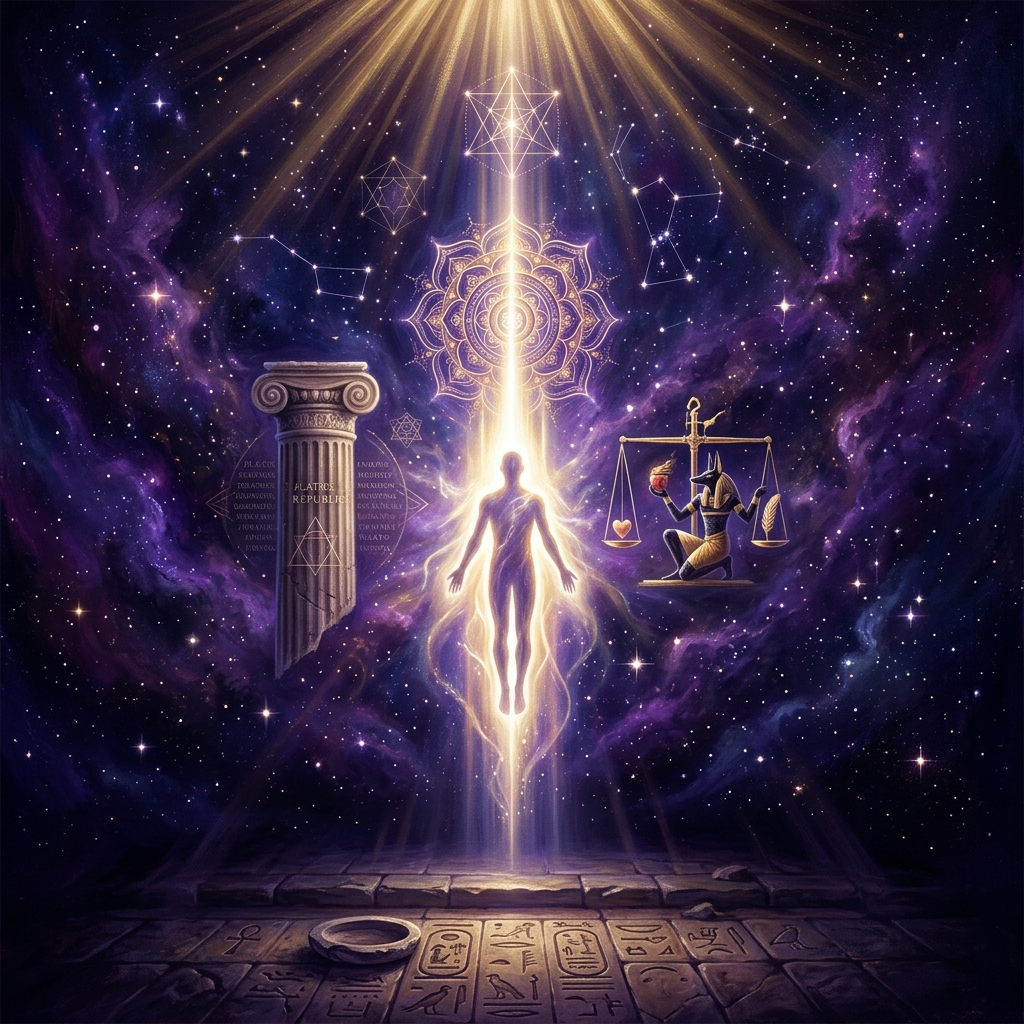
🌌 NDE & Journeys of the Soul
Plato · Egypt · Tibet · Christianity · Modern Science
Near-death experiences are modern in name, but ancient in their symbols. Long before contemporary NDE accounts, philosophical, Egyptian, Tibetan and Christian traditions already described soul journeys, judgments, lights, guides and transformative returns.
MODULE I — Ancient Sources of the Soul's Journey
The Return of Er in Plato
Republic · Book X · Apparent Death · Metempsychosis · Choice of Life
🎯 Understand the Myth of Er as the first Western account of apparent death and soul journey
Er of Pamphylia is a soldier. He falls in battle and is declared dead. Ten days later, when other bodies have begun to decompose, his is found intact. On the twelfth day, laid on his funeral pyre, he returns to life — and tells his story.
Er's soul left his body and joined a multitude of others in an intermediate place — where two chasms open in the earth and two openings open in the sky. Judges sit between these openings. They examine each soul and assign its sentence: the just ascend toward heaven on the right, bearing the sign of their judgment; the unjust descend into the earth on the left, bearing their sign on their backs — for they cannot see themselves what they have done.
These souls spend a thousand years in heaven or under the earth — ten times a human lifetime — experiencing the consequences of every act performed in life. Then comes the Great Choice: souls choose their next life freely from all possible existences. Ulysses, wisest of heroes, chooses the quiet life of an ordinary man — he had enough of ambition. Plato is unsparing: 'Virtue has no master. The responsibility belongs to the one who chooses. The god is innocent.'
The souls then drink from the river Lethe — Forgetting — and return to bodies. Er alone did not drink. He returns with memory intact, as messenger: to bring the living the knowledge of what lies beyond, so each may choose their earthly life with wisdom.
The Egyptian Book of the Dead
Pert em Hru · Ka · Ba · Akh · Weighing of the Heart · Osiris · Thoth
🎯 Understand the Egyptian vision of the afterlife as a precise map of the soul's journey
The Book of the Dead — Pert em Hru in ancient Egyptian, meaning 'Coming Forth by Day' or 'Coming to the Light' — is not a book in the usual sense. It is a collection of magical formulas, hymns, maps and incantations, copied on papyrus and placed in tombs to guide the deceased's soul through the trials of the afterlife. The Papyrus of Ani, housed in the British Museum and dated to 1275 BCE, is its most complete illustrated example.
The human being in Egyptian thought is not a simple unit. The Khat is the physical body. The Ka is the etheric double, the life force. The Ba is what we would call the soul — depicted as a human-headed bird capable of leaving the body. The Akh is the transfigured being of light, what the soul becomes after successfully crossing the afterlife.
The journey leads through the Duat, the underworld. The Ba of the deceased, accompanied by Anubis — the jackal-headed god — crosses a series of Pylons guarded by deities it must name and greet. Knowing a guardian's name means having power over them — this is why the Book's formulas give these names: they arm the soul for each obstacle.
The culminating moment is the Weighing of the Heart. The deceased appears before Osiris's tribunal. Their heart — seat of moral conscience — is placed on one pan of the divine scale. On the other: the feather of Maat, goddess of truth. If the heart is heavier than the feather, Ammit the Devourer destroys the soul permanently. If it balances, Thoth records the verdict and the soul is presented to Osiris — becoming an Akh, a being of eternal light.
The Bardo Thödol — The Tibetan Book of the Dead
Padmasambhava · Three Bardos · Clear Light · Deities · Choice of Rebirth
🎯 Understand the three intermediate states of the Bardo Thödol as a map of consciousness after death
Its exact title means 'The Great Liberation through Hearing in the Intermediate State.' It is not a book one reads — it is read ALOUD at the ear of the dying, then the dead, to guide consciousness in the hours, days and weeks following physical death. Composed, per tradition, by tantric master Padmasambhava in the 8th century, hidden as a spiritual treasure, and rediscovered in the 14th century.
The central concept is Bardo — Tibetan for 'intermediate state' or 'in-between.' We are always in a bardo: the bardo of waking, of dream, of deep sleep. Death is simply another bardo — the most important, most perilous, and most liberating.
Three successive states after death: First, the Chikhai Bardo — at the moment of death, consciousness experiences the Clear Light of Ultimate Reality: a blinding, infinite white light with no visible source — exactly what millions of NDE experiencers describe today. For a trained mind, recognizing this light as one's own deepest nature means immediate liberation. But for most beings, the light is too vast; they turn away. Second, the Chönyid Bardo — for fourteen days, consciousness encounters peaceful and wrathful deities. The text insists: 'Do not fear. These are your own thoughts taking form. Recognize them as such.' Third, the Sidpa Bardo — consciousness is drawn toward rebirth according to accumulated karma, with guidance on choosing a virtuous womb and environment.
MODULE II — From Medieval Visions to Modern NDEs
Christian Visions of the Afterlife
Dryhthelm · Bede the Venerable · Gregory the Great · Vision of Tundale
🎯 Discover the first medieval accounts of soul journeys and their precise anatomy of the afterlife
Dryhthelm, a 7th-century English monk, falls gravely ill and dies in the night. The following morning he returns to life — to the astonishment of those keeping vigil. Bede the Venerable, one of the most rigorous minds of the Middle Ages, records his account in full in his Ecclesiastical History. A being of light guides Dryhthelm through an immense valley — on one side consuming flames, on the other, icy hail. Souls are hurled alternately from one side to the other. His guide then leads him toward ever-increasing light, a meadow of indescribable beauty — but tells him: this is not paradise, only purgatory. The paradise beyond radiates light too vast to bear. Dryhthelm returns with a message: change, and help others prepare.
Gregory the Great compiles in his Dialogues a series of accounts of temporary death with remarkably consistent patterns: out-of-body exit, journey toward light or darkness, recognition of known souls, and return with a moral message.
The most complete text is the Vision of Tundale, written in Latin in the 12th century. Tundale, an Irish knight, collapses at a banquet. His body lies three days warm but without pulse or breath. His soul, guided by a dazzling angel, traverses a precise geography of the afterlife — the valley of murderers, the razor-bridge, the mouth of Behemoth, the devil's forges, gardens of good souls, and finally a palace of ineffable light. He returns utterly transformed. The structure is identical across all traditions: clinical death, out-of-body journey, a guide of light, a moral panorama, an impassable boundary, and a return with a mission.
Modern NDEs & Ancient Symbols
Raymond Moody · Kenneth Ring · Pim van Lommel · Tunnel · Light · Life Review
🎯 Compare the universal patterns of modern NDEs with ancient accounts and assess their philosophical scope
In 1975, American psychiatrist Raymond Moody published 'Life After Life' — a book that would change the history of consciousness research. He compiled accounts from 150 people declared clinically dead and returned to life. Despite radically different cultures, ages and religions, their accounts share a common structure. Moody identifies eleven recurring characteristics.
Here they are, compared to the sources we have studied: The Out-of-Body Exit — the dying person sees themselves from the ceiling. In Plato's Er: the soul leaves the body and observes it from outside. In the Bardo Thödol: consciousness sees its own corpse. The Tunnel and the Light — consciousness is drawn through a dark tunnel toward a light of superhuman warmth and intensity. This is the Clear Light of the first Bardo; the luminous meadow of Dryhthelm; the ineffable light of Tundale's palace. The Life Review — in an instant, the dying person relives their entire existence from the perspective of all those they affected. This is the Weighing of the Heart. The Boundary — a river, a fence, a gate that cannot be crossed. The river Lethe in Plato; the Pylons of the Book of the Dead. The Return with mission — Er as messenger; Dryhthelm and Tundale sent back with moral purpose. The Transformation — loss of fear of death, increased empathy, sense of life mission.
Dutch cardiologist Pim van Lommel published in The Lancet in 2001 a prospective study of 344 cardiac arrest patients: 18% reported rich, verifiable NDEs during complete cessation of brain function. Psychologist Kenneth Ring demonstrated that the deepest NDEs follow an invariant sequence — peace, body separation, darkness, encounter with light, entry into the world of light — regardless of culture or belief.
Scientific caution is required: we cannot conclude NDEs 'prove' an afterlife. But two things are certain: the patterns are universal across cultures and epochs, and they are identical to what Plato, Egypt, Tibet and medieval Christianity developed independently over millennia. Whether neurological, psychological or metaphysical in explanation, this convergence is one of the most extraordinary phenomena in the history of human consciousness.