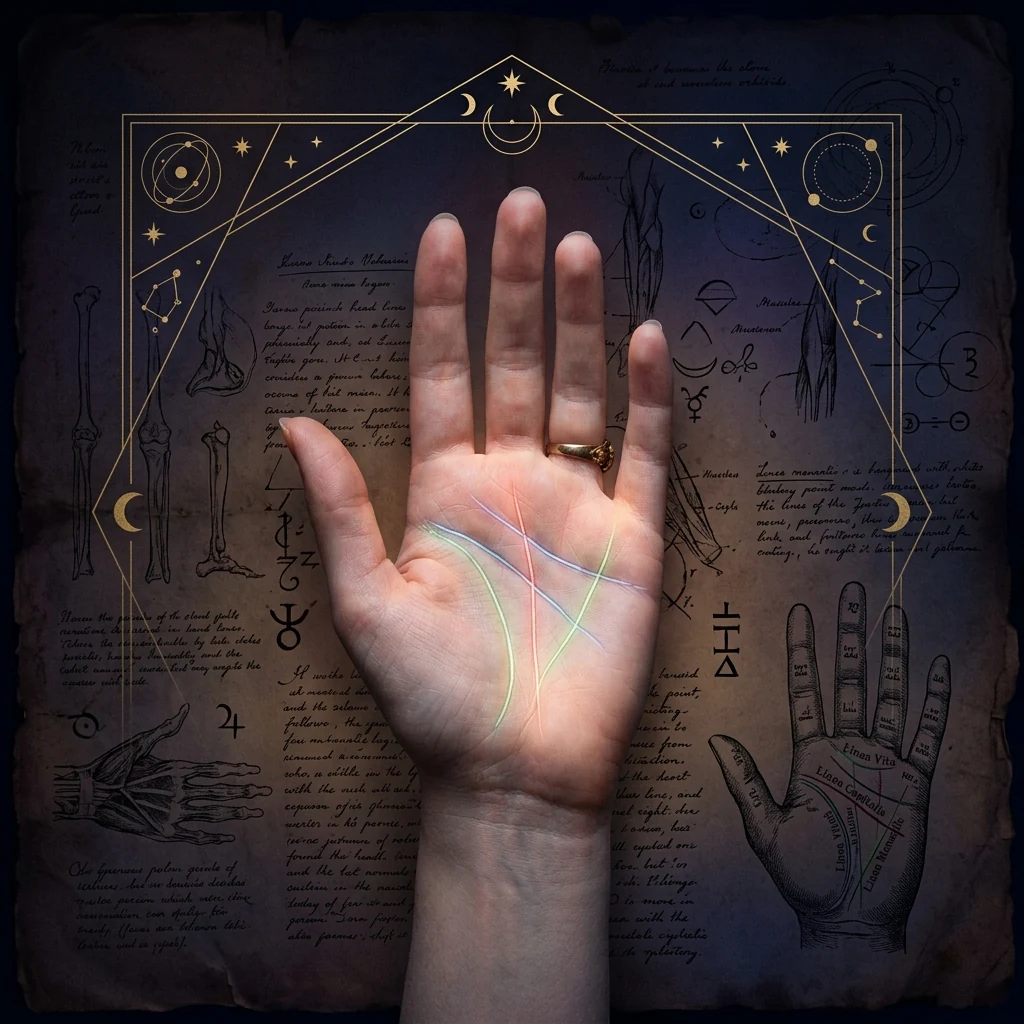
Since the dawn of civilisation, human beings have gazed at their own palms like an open grimoire, seeking to read the secrets of their temperament and the promises of their future. But behind the popular image of the fortune teller lies an overlooked intellectual epic: the 19th-century attempt to transform chiromancy into a rigorous "physiological science."
In his masterful treatise The Practice of Palmistry for Professional Purposes (1897), Count C. de Saint-Germain does not merely compile traditions. He breaks with his master Adolphe Desbarrolles by "playing false" against esoteric doctrines. Where his predecessors invoked the Kabbalah or astrology, Saint-Germain postulates a biological correlation between the hand and the brain. Here are five revelations that illustrate this ambition to rationalise the invisible.
1. The Hand is Not Magical — It is Electric
For Saint-Germain, the hand is not a vessel of spells, but a conductor of "vital fluid" or "magnetic electricity." Influenced by the positivism of his era, he views the human being as a circuit immersed in an imponderable atmosphere.
This perspective moves chiromancy toward a primitive neurology: the hand becomes the terminal of a complex network. Saint-Germain uses a powerful metaphor for his time: the lines of the palm are the "telegraph wires" transmitting nerve impulse to the cerebellum. By emancipating himself from "kabbalistic conjectures," he seeks to scientifically validate the intuition of Aristotle, whom he quotes with fervour:
"The hand is the organ of organs, the instrument of instruments."
— Aristotle, quoted by Saint-Germain (1897)
2. Your Fingers are Reception Antennae
One of the most fascinating theories in the work concerns Chirognomy: the study of finger shape. Saint-Germain postulates that our extremities act as antennae, capturing vital fluid more or less freely according to their acuity.
3. Pacinian Corpuscles — Condensers of Energy
Seeking anatomical proof for his theories, Saint-Germain draws on the discovery of "Pacinian Corpuscles." He notes that the human palm contains between 250 and 300 of these nerve endings, which he describes not as mere sensory receptors, but as condensers of innervation.
The author correlates the presence of these corpuscles with the Mounts of the hand (the fleshy protrusions beneath the fingers). For him, these reliefs are not planetary symbols, but reservoirs of accumulated electricity. He also notes that these condensers are virtually absent in primates and in individuals with congenital brain deficiencies — reinforcing the idea that the hand is the direct mirror of brain activity.
4. The "Rascette" and the Calculation of Longevity
The treatise strikes with surgical precision when addressing the "Rascette" — the horizontal creases at the wrist also called "Bracelets." Far from any poetry, Saint-Germain proposes a mathematical correspondence table to estimate a subject's vitality:
| Visible Bracelets | Vitality Potential |
|---|---|
| One clear, complete bracelet | 23 to 28 years of robust vitality |
| Two bracelets | 46 to 56 years |
| Three bracelets | 69 to 84 years |
The expert doubles as a lucid practitioner. He warns the reader: in elderly persons, the reading is made difficult by excessive wrinkles or prolonged glove-wearing, which can alter the apparent shape of these lines. This methodological caution distinguishes his "professional" approach from simple divination.
5. The Triumph of Free Will over Fate
Saint-Germain's most modern revelation lies in his refusal of fatalism. Drawing on Desbarrolles's work, he conceives the hand as a geographical map where the lines are "warnings" and not condemnations.
Chiromancy becomes a tool of preventive medicine and personal development. A broken lifeline or an over-prominent Mount of Mars are alarm signals enabling one to correct a character defect or an organic weakness through willpower. Destiny is an electric current, but man remains the master of the switch.
"Free will, influenced, it is true, by the flux of vital fluid... remains the proud prerogative of the human race."
— Count C. de Saint-Germain, The Practice of Palmistry (1897)
A Modern Gaze on Ancient Wisdom
By transforming a once-discredited practice into a logical system, Count de Saint-Germain illustrated the fascinating 19th-century tension between science and esotericism. His work is not a manual for fortune-telling, but a bold attempt to map the human soul through its physiology.
If our hands are truly the mirror of our nervous system, they cease to be mere tools of action and become the silent witnesses of our inner state. In the age of modern neurology, Saint-Germain's question remains: what portion of our destiny is already inscribed in the electric network of our palms, and what portion belongs to the "pride" of our will?
🖐️ Explore Chiromancy with Tina
The complete chiromancy course — anchored in the methods of Desbarrolles and Saint-Germain — is available on LearnEsoteric. 3 free lessons, interactive quizzes, and Tina analyses your hand from a photo.
📸 Send your hand photo to Tina in the chat